How to Organize Your Commander Collection: A Brewer-based System for Organizing your Magic: the Gathering Cards

A Magictation by Mikeal Basile

“Magictating” is defined as getting into the zone with your Magic the Gathering collection–thinking, planning, organizing, reminiscing about past games, and imagining future games. It is a combination of hard thinking about the game and calm meditation, reveling in the joy it brings you.

The Case and Theory behind using the CCNC 

I have several New Year’s Resolutions this year: exercise goals, Magic the Gathering collecting goals, deck building goals, writing goals, and organization goals. Today, I’d like to share with you my method for organizing my 100,000+ cards. You don’t have to have a large collection to benefit from this system, and it works really well at all levels of collecting. It’s a system based on deck construction and creativity. Everything I’ve learned about organizing has come the hard way; for me, it does not come naturally. When quarantine began in March of 2019 I decided to stop procrastinating and finally reorganize my collection. In years past, my play group had traditionally been playing sixty card multiplayer decks, but the last several years we had only been playing EDH/Commander. So, I decided to reorient my entire collection and put the sole focus on Commander deck construction. Now, there are many theories out there as to how to organize your collections. I’m offering you my method which I have dubbed the CCNC system of organization. It consists of breaking things down by color, creature, non-creature, and casting cost (CCNC). I have used this method for years, but I hadn’t applied it to my entire collection until now. It works at all levels of collecting. If you just started collecting or if you have tens of thousands of cards this method is what you, as a Commander player and collector, should be using. The CNCC system helps stoke creativity and enjoyment, so let’s get to the fun of organizing (said no one ever).
The Need for Organization:

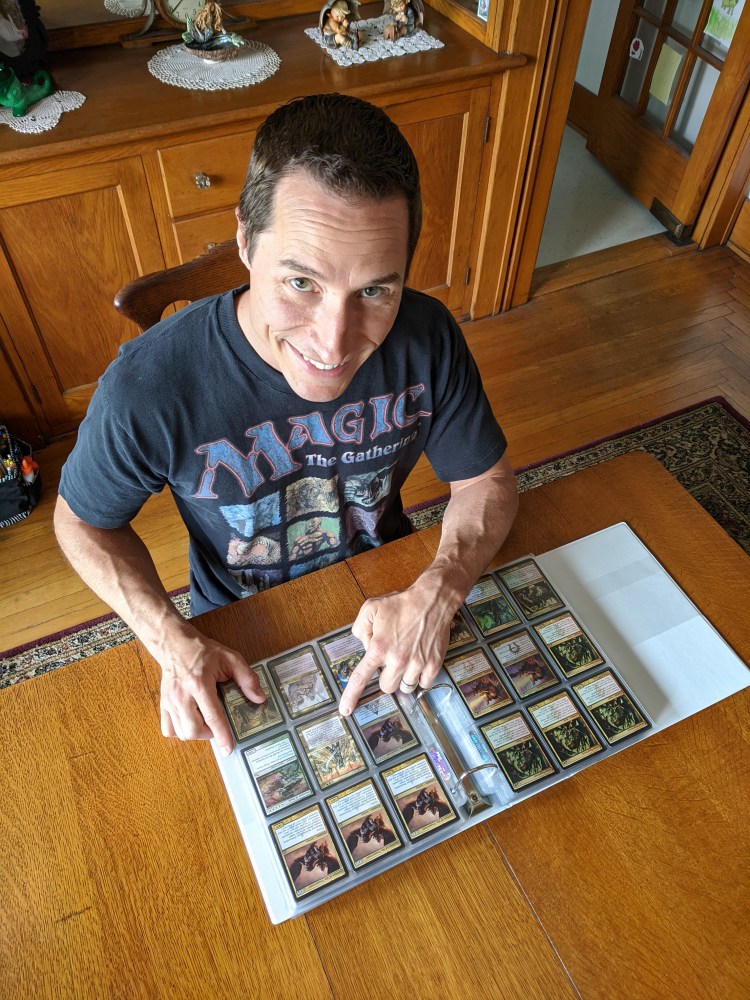
To provide some context here is a summary of what my collection consists of at this time. I did not always have such a large collection. For at least my first year I could fit every card I owned inside one little box. However, my collection has grown steadily over the last 25+ years, and having a system like I employ now will only help you keep your collection in a much better place than mine was for the last ten years (read organized chaos). Currently, I keep nine different binders that are for mythics, rares, and powerful uncommons. I keep my commons in a 72 drawer card catalogue. Yes, the kind that used to be used in libraries to house Dewey Decimal system cards, but is now employed to hold my 90,000+ commons and uncommons (kids, ask your parents if they know what one is). I keep my Commander decks in 6 Stanely 10 Compartment Pro Small Parts Organizers. I’ve used and owned many other deck cases over the years, but from a utilitarian and budget perspective these simply can’t be beat. Additionally, I have a Cube (for drafting) that is stored in a customized wooden box. These cases reside on the shelves next to my card catalog. Now that you know what I’m dealing with, I’d like to explain a whole lot more about how you can get yourself so blissfully organized.

My wife has repeatedly told me that organization is not something you do in one day, but something you do a little bit every day. She’s right, but I had to catch up on not doing any for years, so I was doing it all-day for days and days. I went through nearly 70,000 cards (maybe more). It’s worth it, and if you’re behind on your organization, then don’t worry overly much. Every bit that you do now is a bit that is done and won’t need to be done ever again. When your approach is positive then every step you take is a meaningful step toward the goal of being fully organized. You just need to keep a positive attitude, and trust that you will save so much time and money by having your cards properly organized. 

The Theory and Case for using the CCNC Organization System.

I developed this system years ago, and it is all backed with solid reasoning. I wanted my collection to be organized in a way that helped me build decks, so I broke down my deck building process and analyzed it. Once the initial inspiration for a deck strikes me, I like to pull out rares I own that can go in the deck. So, all rares are in binders by color. I further separate the color into creature and non-creature spells. Again, this wasn’t always the case. When I was just starting out, I used to have only one binder, and then I had a trade binder and my keep binder. Now, I have a binder for each of the five colors, one for colorless, one for lands, one for multicolor, and one for trading. The rare binders work out really well, as I don’t organize much beyond creature or non-creature spells. The cards are just slipped into the binders as I collect mythics, rares, and powerful uncommons (like Swords to Plowshares). Having these cards semi-organized within the binder allows you to quickly find the cards you think you want, but also allows you to stumble upon cards you didn’t even realize would be great in the deck you’re building. Yet, if I had opted to organize like a card store, and put everything by set, color, and alphabetical order, then I would easily skip over cards that could have offered me some great memories and fun times. If you don’t have the money to invest in keeping binders, then using boxes and color-coded dividers works well too. You end up picking up your stack of cards, and rifling through them to find that rare. While doing this you tend to stumble upon some truly serendipitous synergies. This is a great way to make use of “bulk” rares and other cards that can otherwise end up dusty and forgotten.

Once I have selected rares for my new decks, then I fill the deck out with commons and uncommons. I am often thinking about the mana curve in my decks, and how I need to make plays at all stages of the game. This is why I separate my commons and uncommons not simply by color, but by casting cost as well. I actually separate them into colors, creature or non-creature, and finally by casting cost. I have found this is a truly wonderful method for spicing up your decks and finding interesting cards to play that were buried in your collection. You might be building and realize that you have almost nothing in the three and four drop slots in your deck. Well, now you can go ahead and peruse all the cards in those slots quickly and efficiently. This also allows you to stumble upon interesting synergies and fun cards that otherwise would be lost if we were to have our collections organized like a store. I’m not interested in selling my cards or putting my hands on a card as quickly as possible. Hence, I eschew the alphabetizing and expansion set system of organization. I want my deck building process to be as organic as possible. That’s why I don’t go beyond the CCNC level of organization. It enables me to quickly find a card that I know I need, but also allows me to mine my collection for hidden gems. I can’t stress enough that over-organizing your collection really can lead to stifling your creativity. When I’m magictating, I want to be able to get lost a little bit in the magic of the moment. I want to reminisce with my older cards, and maybe toss in a few sub-optimal cards in order to revel in the nostalgia they offer. I assure you the CCNC system is an excellent balance of efficiency and creativity.

Committing to Commander

Perhaps you are still hanging onto your old multiplayer sixty card decks? Well, for me, I was until I finally took the plunge into Commander full throttle. So, I began breaking down all of my old decks. I had over thirty unique sixty card decks built. As I did this I found that I kept stumbling across ideas for Commander decks. I realized that I needed a system for beginning new decks. I started by using boxes and divider labels. Often I didn’t even bother labeling the idea, but instead just put the Commander or thematic inspirations for the deck in front of the stack of cards as I went. While you keep on organizing you can create several piles that will be developing into what could be some seriously new and different decks. Think of it as creative pile shuffling.  With deconstruction finished we can turn our attention toward separating commons and uncommons by color, creature vs non-creature, and finally by casting cost.

Time Saving Tips: 

I have a few pro-tips when it comes to organizing using my system. Begin by separating everything by color. Once you’ve got commons and uncommons into their respective colors flip the cards upside down so that the power and toughness for creatures is at the top and begin sorting between creature and non-creature. This makes the process go by incredibly quickly. I have sorted tens of thousands of cards this way, and through some trial and error I found this was the most expedient method available. Once you have creatures and non-creatures separated, then you can sort them into their casting costs using a typical mana curve pile. It’s like building a draft deck, but this time it’s just to ensure the curve is grouped appropriately. This is the part where you really start to re-familiarize yourself with your collection, and you’ll often want to have those deck idea piles handy. I found myself dumping many cards into potential new builds as I did this. This will save you building time later, and help you keep your inspirations moving forward. The synergies you will notice during this portion of the process are priceless. You will be so happy that you discovered such interesting cross-overs among the various expansion sets by getting organized. I often find myself making connections between sets that have over a decade separating them.

Organizing this way isn’t necessarily an onerous task. It can actually be quite fulfilling, interesting, and downright fun! No, Huck, I’m not pulling a Tom Sawyer on you here. While I was in college I would often sort through freshly purchased bulk collections for my local game store. They would reward me with first crack at anything I found, some store credit, and a small discount as well. I spent hours sifting through cards and pulling out rares, powerful uncommons, and building cheap commons decks all while sorting for the store. This was before Pauper was even on anyone’s radar as a format. My play group built commons decks for fun, because we wanted a way to utilize all our commons and provide a decent play environment while doing so. All commons decks were a cheap way to get more variety into our Magic lives, and I built many a deck from those hours of sorting. When you’re sorting your own collection the best part is that you already own all of these cards, and you get to not only keep them, but play with them in new and interesting ways. The further behind you are in organizing cards the better it is for finding fun new inspirations and jumpstarting those decks you’ve always wanted to build. Having a large task ahead of you actually means you have more opportunity for finding fun. Enjoy it! 

Savoring the fruits of your efforts:

Once you have your cards sorted I believe you will find that building your decks will not only be faster, but also more enjoyable. You will easily be able to pull out the cards you look for, but you will also enable stumbling upon wonderful new synergies as you do so. The variety of cards available to Magic players is one of the best parts of the game, and the Commander format lends itself to this type of variety. Organizing things in order to put your hands on them as fast as possible is really something for a gaming store. Their job is to move inventory and get the product in the customer’s hands. Your job as the architect of your own designs is to build and build with joy. If you over-organize your collection, then you run the risk of losing out on some of that deck building joy. The reason some people don’t enjoy deck building is really because they are going about doing it without investing themselves and their own ideas into the build. It is akin to following a Lego instruction manual or going it on your own. Sure, you can build a really cool castle following those directions, but you can also build your own space castle with rotating gargoyle turrets that has a built-in sky dungeon. Basically, don’t be afraid to create, and learn to love your own creations by not only enjoying them as a final product, but enjoying the process of bringing them into being.
Parting thoughts on using the CNCC system of organization:

Being a brewer is another way to bring more joy into your gaming world. Your friends will love seeing what janky new rares and quirky commons and uncommons you have managed to cobble together to create interesting and impactful plays. I think back on all the decks I have built over the years, and I realize that my spiciest decks were all inspired by cards I’ve stumbled on while building other decks. This serendipity of random discoveries only increases the joy of keeping and maintain your collection. My system is not merely one for retrieving cards to slot into decks like a machine or computer program. This is an organic system that feeds your need to create. It helps keep you from getting stuck in the creative process and offers built in ways to keep your creativity percolating. The CCNC system is also based on fundamental elements in deck building: creatures, non-creatures, and mana curves. There are many ways to organize your cards, but using this method allows you to be both free and efficient.

If you enjoyed this article, then please consider subscribing to my blog. Subscribing will send new articles directly to your inbox (about once a week, so your inbox won’t suffer). You won’t have to check back to read any fun new Magictations. Thanks for reading!

Spoiler Free Results: The Land of Ice and Snow

A Magictation by Mikeal Basile

“Magictating” is defined as getting into the zone with your Magic the Gathering collection–thinking, planning, organizing, reminiscing about past games, and imagining future games. It is a combination of hard thinking about the game and calm meditation, reveling in the joy it brings you.

I conducted an experiment where I avoided every Kaldheim spoiler prior to opening my own packs of the set. If you’re wondering why I would do such a thing, then perhaps I should go back to this being an experiment. My basic hypothesis was, “If I avoid all spoilers will I be able to recreate the wonder I experienced when I opened up my first packs of the original snow set—Ice Age—and would it be worth the self-imposed exile on all spoiler season venues?” This is based on the concept of whether or not I could recapture the joy, mystique, and wonder that I once had while opening packs of cards in my early days of playing. In order to do this, I successfully avoided every spoiler throughout the spoiler season. I was purposefully trying to see if I could re-create the wonder of coming to a Magic: the Gathering set with only tangential knowledge similar to what I would have been exposed to during the mid-90’s. I learned much from this experiment, and I’d like to pass on some words of wisdom.

If you’re unsure if this experiment is worth it, then let me explain a bit more. When I was new to Magic it was amazing to me that there were so many cards in existence (at the time there were a whopping 4 expansions out). I remember that a couple years later there was a new set called Ice Age that was coming out. There was some artwork out and some rumors circulating about a Jester’s Cap card that was incredibly powerful, but no one in my circle knew exactly what it did. The mystique was there. The wonder was there. I was so excited to open my first starter box (think 3 boosters crammed into a box with lands as well). The box had a crazy looking wurm (Scaled Wurm) on the cover that was back dropped by snowfall. As a fan of the original Craw Wurm, I was excited to see what this scaly new card had in store for me. The snow-covered lands were also exciting, but not nearly as exciting as the the two sets of dual lands they printed (Land Cap and fellows were the counter lands and Adarkar Wastes and the gang were the original pain lands).  I had heard about those as well. However, the most exciting part was that I had no idea what I would find in there. I look back fondly on those days, and I wanted to try and recapture a bit of that wonder. I’m not saying I don’t enjoy today’s modern spoiler season. Spoiler season and the internet do a great job at hyping everyone up for a set by showing off new cards, explaining interesting new mechanics, and ramping up people’s expectations for what lies in their packs. However, spoiler season also spoils the wonder and mystique of opening packs. I’m not arguing for or against it, but rather just sharing with you my experience as a modern player attempting to relive the wonder of un-spoiled Magic.

At times I have been bummed by this experiment. So many opportunities for instant gratification have lurked just a flick of my finger away. Twitter, Facebook, Instagram, YouTube, and my Google Feed all wanted to push spoilers on me. I was able to avert my eyes and my attention away from nearly everything of substance. I was exposed to artwork, and a few names, but honestly the exposure was so brief that I couldn’t remember the names of cards I had read, and the artwork really just ramped up my interest. In that way it was very similar to the feelings I had during Ice Age’s arrival.  In the interest of transparency I did happen upon the following bits of information: there is some sort of rare land cycle, there are gods, there are legendary weapons, and snow-covered has made a return. None of these were surprises for me as I actually anticipated each of these based on my experience with previous sets like Theros, and Amonhket. Theros was also exciting for me, and I anticipated Kaldheim to be a similar experience. The rare land cycle made sense, and the knowledge I possess of Norse mythology is good enough to pass any college course’s requirements on the subject. So, I figured the design team wouldn’t drop the ball on including major elements of Norse mythology. Having read and studied Beowulf in graduate school, I was ready for some epic sagas. I’ve long been a fan of nearly all mythology; so, yeah, I have been super excited for this set. However, the overall doom and gloom that surrounds much of the Norse pantheon had led me to feel that this set was going to be much darker. I saw some artwork, and other elements, but those only made me more excited to finally open some of this product. Basically, the artwork being spoiled did nothing to actually spoil my experiences with the set. I actually feel that there may be a case for spoiling artwork and using it to ramp up interest on its own.

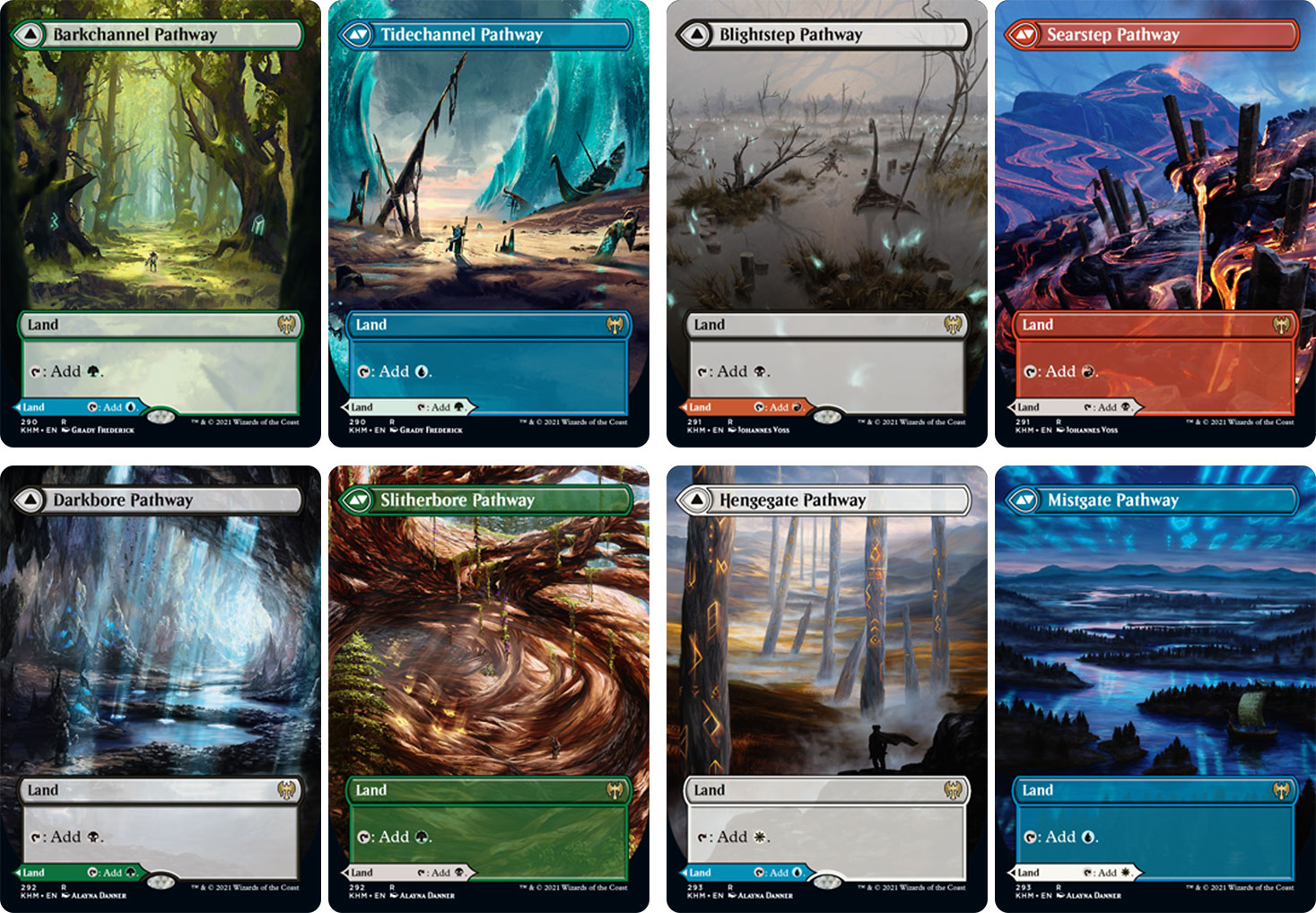
When I finally got my box of booster packs I was giddy with anticipation. My brother and friends still couldn’t believe that I had managed to avoid all spoilers. I was approaching this moment as an unspoiled brat. Now, I say this because I did buy a pre-release kit, a bundle, and a booster box. That would have been an absolute crazy amount of product for the kid I was in the 90’s to afford. It basically was akin to getting super spoiled for my birthday (which isn’t until March). When I first opened my pre-release kit I was so excited to see a Barkchannel Pathway as my very first rare. This isn’t much different from how I was back in the mid-90’s. I loved rare lands back then, and opening them up now is still exciting for me. I was weird that way as a newer player. It usually takes people a few years to realize how important lands really are, but I had warmed to them quickly as I was always trying to play as many gold Legends as I could. The joy of opening a Barkchannel Pathway as my first card was quickly replaced with the feeling that it wasn’t really that great, because now I knew which Pathways would most likely be in this set, and it was just a cycle being finished off. Overall, it was exciting, but also a clear warning sign that this was not going to be the same thing I used to experience as a newer player. I know too much about the game and development and product design. My knowledge was thwarting my ability to live in the moment. I was familiar with this exact land style, and so it was cool, but not terribly exciting. I also instantly knew which ones were going to be showing up in set, so a bit of mystique vanished from the onset. I had somehow spoiled myself already. Darn. In some ways I’ve found that you can’t turn back the clock.

Now, once I got into opening cards I was so excited to see the showcase treatments. These managed to look like Magic cards (unlike those monstrous Invocations from Amonkhet), but also looked special and uniquely made for this set. I love this fancy treatment. I also enjoyed seeing so many Legends in the set. Wow, it’s like Commander Legends part two. I was blown away by how many legendary creatures I kept opening up. This was very exciting, and made me spend quite a bit of time perusing not only my rares, but the uncommons and commons as well. It felt a bit like I was trying to become a better drafter of the set, but my focus wasn’t on drafting. I was studying the cards with interest and wonder. I found myself reading flavor text for clues. I recalled doing that during the Ice Age expansion to try and figure out what the deal was with Leshrac and if he was a card or not. I was scouring the italicized words to find hints about other cards and characters. I desperately wanted to know who was next, and I kept thinking that I was so excited to open the next unknown. I was digging for clues to what was next, but it was less a spoiler reveal, and more a detective novel. I kept picking up clues to other characters, thinking about the potential plot, reviewing sagas, and then being amazed that there was a Tibalt Planeswalker that was actually good. It was actually a bit overwhelming. A splendid sort of overwhelming. Opening Tibalt as a showcase card was exciting for many reasons. I had already stumbled across the Pretender Saga, and so I was reasonably sure Tibalt was going to be in the set. Once I found him and realized he was the Loki of the set, then I truly loved this whole ridiculous take on Norse mythos in the Magicverse. The wonder and excitement were definitely back. I would never have been so eager to read about the story or the pour over flavor text and mechanics for clues about other cards had I devoured all the spoilers. I definitely was able to bring back the mystique.

As I opened more cards and reviewed pack after pack I realized that I had spoiled something else. I had spoiled myself beyond any nostalgic feelings I had from the past. I don’t think I could ever afford so many packs at once until I was in college. I never bought anything but singles and occasional packs prior to having a decent job, and therefore a decent Magic budget. For me, this gluttonous greed with my pack cracking was really just a spoiled brat moment. I was spoiled by being able to have so many cards all at once. I think this is fun, but also something that can take away from the collector hunt that can develop when on more limited funds. I don’t think it’s necessary to instantly gain access to every card in a set. In some ways it rots away the joys and wonders of opening new packs. It’s similar to studying the spoiler sheet prior to opening. It becomes a chore to open pack after pack, and that just shouldn’t be the case. If this is your hobby, then you should enjoy it. If you like to collect cards, then collect them while having fun doing so. I felt that buying so many cards at once killed the joy of the hunt. I now only had a few rares and mythics to chase down. That’s a bit of a bummer, and definitely was something I didn’t anticipate about this experience. I’m still happy to have been spoiled rotten and all, but it does take away from the hunt.

I know that many Magic players suffer from FOMO (fear of missing out). I get it. I know you are worried about not picking up a card before its price soars beyond your budget. So, I know that many of you think that if you study the spoilers and predict which cards are great before everyone else, then you will be able to either make a buck or save some bucks. You may very well be right. However, those types of pickups usually happen after the first three weeks a set has been out. The market is typically flooded during the first two weeks. All those pre-order prices come back down to reality, and competition lowers the prices a good deal. I find myself ordering many singles during that second week after a set releases. This is also the time when tournament results for Standard start to add up, and that’s around the same time when new decks show up. This sweet spot isn’t affected by spoilers. Your knowledge of the set doesn’t have to hamper you from this. You can easily pick up cards or sealed product during the first week of release, and then still pick up the cards you need at excellent prices. Standard sets have plenty of product printed, and you don’t need to be fearful of not getting your hands on it. As a Commander player, you should know that time is usually on your side. Avoiding spoilers didn’t cause me to miss out, and actually ended up helping me enjoy packs even more. This experiment really seemed to work out pretty well.

Spoilers have spoiled some things for me, but at the same time I feel they have offered me plenty of excitement in their own way. They are a form of instant gratification. Spoilers give me knowledge, and as we know, knowledge is power. I can have knowledge before others, but what I do with that knowledge determines its power. Do I use it to plan decks? Do I pick up cards others might not realize work well with the newest cards? Should I suddenly stop everything and buy up every Beta Craw Wurm ever printed (the answer to that is always yes). Spoilers can be great when they are done right. It’s similar to a good movie trailer. The good movie trailer should tease the elements of the movie, clarify the genre, and give me a taste of what is to come. The worst movie trailers act as summaries of the entire film; you watch the trailer, and you’ve basically seen the whole movie. The same is true with good Magic spoilers. The spoilers that discuss ideas, present themes, and flesh out concepts or tease bigger moments are the types of spoilers I’m interested in consuming. Seeing a list of cards is just someone giving me the answers to a test without offering me any real knowledge. I don’t care about the simple mechanics alone. I want some drama, some story, some synergy, and some mystique. Let me discover some things on my own and they’ll mean an awful lot more to me. Spoiling yourself with spoilers can kill much of the fun that a Magic set initially has to offer. Yet, when spoilers are done right they build excitement. However, spoilers can also limit the joy of discovery, and I would personally rather have no limits on my Magic moments.

Spoiler Free

A Magictation by Mikeal Basile

I am a bit behind on getting this article up here on the site. I will posting the follow-up to this shortly afterward. I won’t spoil the outcome for you….

I am conducting an interesting experiment. If you haven’t already seen Kaldheim spoilers, then I invite you to not look at any. I have kept myself spoiler free for this set. I wanted to do this in order to share with you all what it is like to approach a set with no knowledge other than second-hand accounts, hearsay, and general hints from the Wizard’s marketing department. If you’ve already been devouring every spoiler and leak the minute it comes out, then I suggest you consider my notes on this and I would strongly recommend that you try it with the next standard set instead.

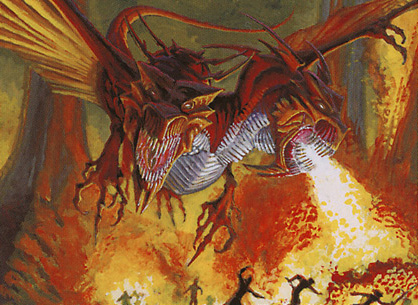
If you collected in the 90’s or even the early 2000’s, then you could easily have gone to a release tournament with almost zero knowledge of what cards were in the set. Those that were very ready for the limited format were usually studying lists and spoilers prior to event day, but the average player, which I assure you I was and still am, would end up being delighted by opening each pack and pouring over commons and uncommons while slowly getting to that sweet new rare. I still remember going through my Mercadian Masks sealed pool and coming across Two-Headed Dragon. That was a beast of a beauty in those days. I had a dragon deck of sorts with Shivan Dragons, Volcanic Dragons, a Crimson Hellkite, and Dragon Welps, but this Two-Headed Dragon was super exciting. Also, it was a bomb in limited. I easily flew into second place that day, but I assure you I was riding the wings of my never-before-seen Two-Headed Dragon. That experience was all the more memorable because I had never seen that card before. Years later I attended the Shards of Alara pre-release, and I had only the knowledge that it was a set with new mechanics. I didn’t even know what those mechanics were, but I opened another fiery bomb of a dragon—Predator Dragon. I proceeded to live the dream and flew on fiery wings all the way to the winner’s circle. It was a grand day, but it was so much more special to me, because the cards were all so surprising and fun. I mean I can picture exactly where I was when I opened that dragon. Local gaming stores are such wonderful memory makers! Anyway, my point is that sometimes it is great to leave a little mystery in your packs. I think that is part of the reason those Mystery booster packs were so much fun to open…it was mostly a mystery.

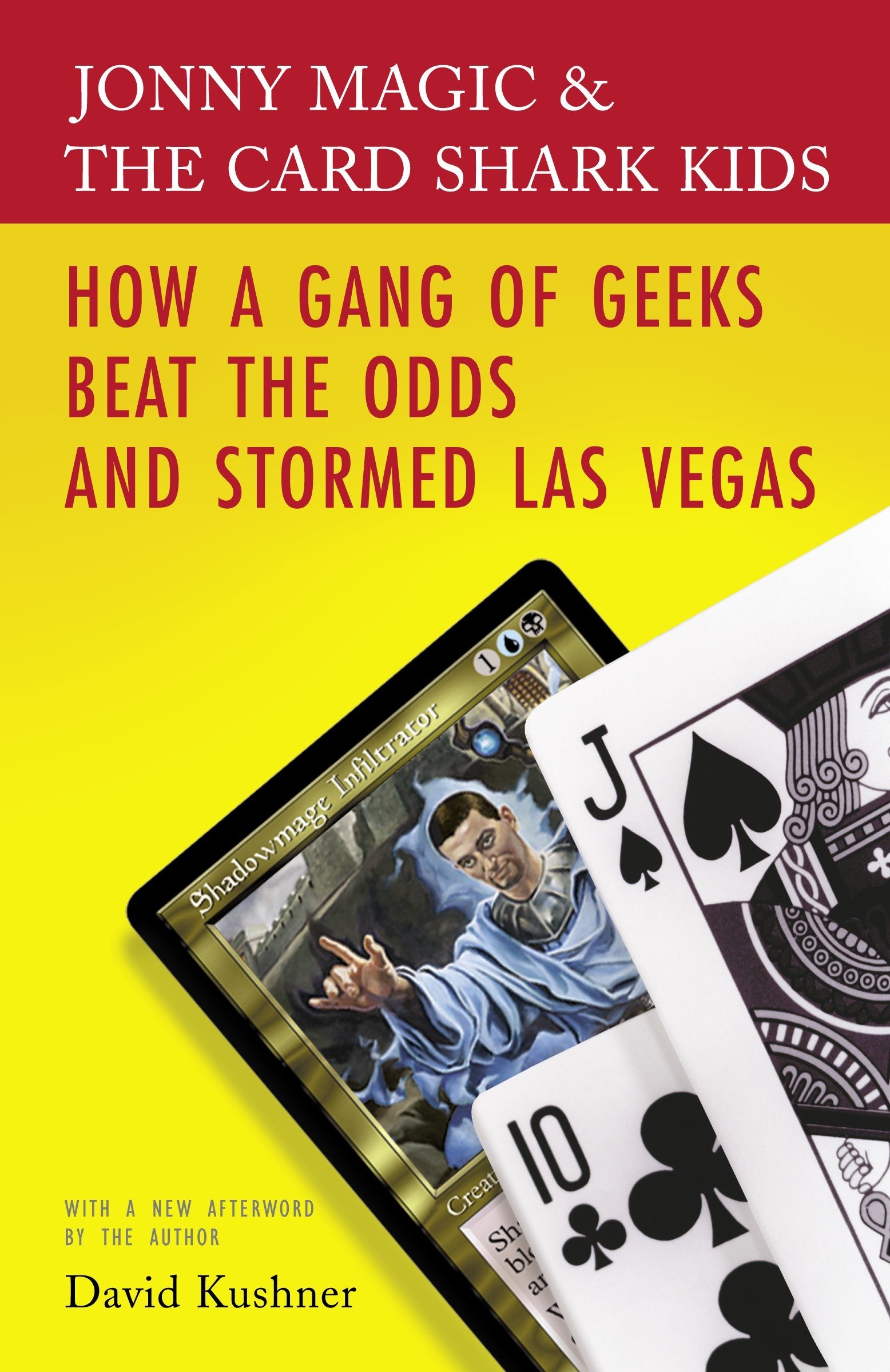
Collecting in the times of full spoilers and reveals is fun, but it does come at a cost. We lose the mystique and wonder of what is inside each pack. Sure, we know that we are getting big monsters when we open Ikoria packs. We know those packs come with some mechanics about mutating creatures into larger (or just more keyword heavy) monstrosities. Yet, once we know the set and the cards, then when we rip open a pack we never have that reveal or that moment when we stumble across something new. We don’t have that chance to pass the card to our friends and watch them read it in disbelief that such a thing exists. We often don’t have the opportunity to squabble over how exactly these new rules work (though that’s perhaps not a bad thing). As a collector in the 90’s this happened almost every time we sat down to play, and I assure you there were far fewer cards in those days. I remember reading a passage out of Johnny Magic and the Card Shark Kids that discussed one of Richard Garfield’s ideas for the game when he was first creating it. He wanted people to be able to stumble across new cards while playing each other, and have to figure out how to deal with unknowns in the context of the game. He thought it would be a good thing for everyone involved to be able to have new cards that no one knew about and be able to sling them back and forth with another. This is truly an amazing aspect of the game.

The surprise factor of the getting new cards, and being exposed to new cards is something that has virtually disappeared for me. There are a few sets that I’m not wholly familiar with, and so I do get to have these moments from time to time, and they are great! This is what has inspired me to try and recapture that surprise feeling. I love when I get destroyed by something new, and then I promptly put it on my acquisitions list to go buy or trade for it later on. I love seeing new cards and watching them work in action and then deciding to either combat them or pick them up myself. That is something that just doesn’t happen when you study every spoiler as it releases. I know, because I’ve been doing that for several sets now. The surprise factor disappears when you know each and every rare and mythic before you crack a single pack. Sure, the excitement of each card is enjoyed in the moment of its reveal. That surprise factor still happens, but the moment of discovery is removed from the pack, play, and overall collecting experience associated with Magic’s traditional distribution of packs. Buying a card as a single has always been possible, and so going to your LGS and finding the newest cards on sale and looking through the glass case at wild new cards is another way to harness the joy of discovery. Nothing replaces that nostalgic feeling of unearthing what you didn’t know you needed in the display areas of your LGS.

I don’t have anything against searching out spoilers. As I stated earlier, I have routinely reviewed, studied, and even speculated on spoilers in the past. I was living and breathing the spoilers for Commander Legends. My point and purpose is more that I want those of you that haven’t tried to experience a set without internet spoilers to try it out. It is really quite interesting. I think if there is no pre-release tournament scheduled, or release date events, then what have you got to lose? You can try experiencing something that just doesn’t happen anymore. You can discover new cards, play with them, build with them, and keep the whole experience as an in-person moment. Building memories and joy with your collection is an important aspect of acquisition. I am very much looking forward to sharing my experience with you, and I hope you are able to join me. Now, to be perfectly transparent, I’m still planning on preordering at least a booster box of this set. I mean, I love Norse mythology, and I loved that Theros plane both times. How can a Magic possibly disappoint me to a degree that I regret picking up some product? Exactly, I don’t think I’ll be regretting a blind purchase. However, if you’re tighter on budget you might find it interesting to note that most cards are actually cheapest a week or so after the release. So, all that spoiler speculation…well, it really is just speculation.

I’ll be sure to let everyone know how I feel about the experience afterwards, and give you the run down on the positives and negatives of the overall experiment. Spoiler season is a thing, and the very concept of that has waxed and waned over the years. In the past, I have embraced spoilers, but now I’m curious how things might be different if I choose not to hop on the hype train. The New Year is a time for reflecting and looking forward, and I feel that this little experiment is just one way in which I plan to do exactly that. Ironically, I’d like to close with a hint or spoiler for my next article. I am currently embarking on a new collector’s quest, and it’s a doozy. I’ll be a week or so into it by the time you read about it and the article is published, but I think you’ll all find it to be a little crazy and is totally worth watching.

-A Magictation by Mikeal Basile

“Magictating” is defined as getting into the zone with your Magic the Gathering collection–thinking, planning, organizing, reminiscing about past games, and imagining future games. It is a combination of hard thinking about the game and calm meditation, reveling in the joy it brings you.

The 2021 Card-A-Day Challenge

A Magictation by Mikeal Basile

“Magictating” is defined as getting into the zone with your Magic the Gathering collection–thinking, planning, organizing, reminiscing about past games, and imagining future games. It is a combination of hard thinking about the game and calm meditation, reveling in the joy it brings you.

I’m a collector at heart. I also love to play games. Magic the Gathering offers me the best of both worlds. I love Magic, and I love hunting for bargains. Those of you that know me are well aware of some of my more epic finds while bargain hunting: eBay misspellings, garage sales, flea markets, and even that quarter ton of cards my wife found on Craig’s list. I am always hunting for bargains and good trades. In the spirit of the New Year, and exciting resolutions I am taking on a new Collector’s Quest. I have done several of these during the last couple decades, and I highly recommend that you do one yourself each year. The sense of gratification that comes while feeding your need for more Magic is indeed wonderful, but I find that the hunt itself is where most of the joy lies. My challenge for this year is as follows: I am going to purchase a Magic card every day during 2021.

I never have the appropriate sense of dread whenever I start anything, be it big or small. You can call it dumb or you call it optimism, but in the end it’s just who I am. I love taking on challenges, and the harder they are the more excited I am to tackle them. My wife warned me that it may sound fun, but it will eventually become work. I am more than happy to find out if that’s the case. I’ve decided to follow some simple guidelines to ensure that the journey is as fun as possible. I must purchase a card each day specifically for this collector’s quest. This means I can’t buy seven cards on a Monday and be set for the week. Each day I will need to make a conscious decision about what card I’m buying to complete the 2021 card-a-day challenge. It takes effort to buy a new card every single day. As I’ve said, I’m a bargain hunter, so I’ll be sure to be budget conscious while I make my selection each and every day. Any large purchases I will be attempting to make through my LGS, and so I may need to schedule curbside or store visit hours accordingly. Again, it’s worth it to me to take that extra step. I will not be taking short cuts or opting to purchase random cards or packs or any other sealed products to complete this. It’s actually really simple: select a single card to purchase each day, and buy it.

I have several other collector quests going on, and I may be able to kill two birds with one stone on a few of these days. I anticipate that I will also be combining this with other collecting quests that I have made for myself throughout the years. I never did complete the set of original legends from Legends, but perhaps this is the year that I make that happen. This may be the year I finish the task of building a Commander Cube for drafting. I will surely inch closer to completing my quirky artifacts collection, and my Mega Cube could use some rounding out and updating as well. I am only one Bayou shy of righting that childhood wrong, so perhaps I finish that quest this year as well. All of those and more are possibilities, but I think that each day will bring new surprises and new revelations about collecting Magic in the 2021.

I anticipate being able to share many of the lessons I learn about purchasing, collecting, prioritizing, and executing this challenge. I intend to keep all of you updated with a monthly summary of my experiences. There will surely be many things I stumble across while doing this, and I can’t anticipate what hurdles will arise, but I’m going to let you know what it took to get over them, and what you can do to help guide your own collector quests throughout 2021 and beyond.

The biggest challenges that I can foresee would be the ability to purchase a card each day when and if I go on vacation. The answer here is simple, but I may be wrong. I think the internet and 4G/5G access should allow me to make a purchase anywhere on any given day. My LGS even has a way for me to set up buying online and doing curbside pickup! How sweet is that? Answer—very sweet indeed. The other way I anticipate this challenge to be difficult is if I have a lot going on in my life and I just don’t think about Magic for an entire day. That’s technically possible, but unlikely. As Billy Bean once said, “I hate losing more than I want to win.” That’s my favorite quote from Money Ball, but essentially this means I will be motivated to buy a cards simply not to lose. Losing to yourself is still losing! Well, at least for me it might be. I think the act of being on-it every single day could make it less fun, and especially if I start seeing it as a chore of sorts. I am not overly worried about that, but we shall see if it truly becomes an onerous task. I suspect that my inherent collector’s greed will power past such feeble obstacles!

Now, to make this even more fun to look back on, because who doesn’t enjoy looking back at the zeal they had at the start of a New Year’s Resolution? I’m going to make a few predictions. I’ll be sure to check how I did at the end of the 2021 calendar year, and we can see if I was right or tapped-out.

1. I will complete the quest by actually purchasing a card every single day.

2. I am going to struggle finding cards during the Summer months

3. I will have zero shipping, delivery, and pick-up issues with the cards I purchase.

4. I will spoil myself on my birthday.

5. I will find at least one card from Beta to purchase.

6. I will buy more black cards than any other color.

7. I will purchase from unique stores while I’m on the road.

8. I will be sad to be done with this quest and will choose to repeat it next year.

This quest is a way to feed the greed. It’s going to be fun to find a card on each calendar day in 2021. Discipline will be key—I have to utilize my instincts, and mobilize my inner greed monster. As I write this article it is December 30th, and I’m so excited to start down this path. I am looking forward to sharing the progress and the insights I gather from this mammoth collector’s challenge. I think that we will have many stories to share during the course of 2021, and I hope that we might even be able to return to some normalcy. I’m hoping that we can play Magic in-person again, and trade cards in-person, and meet at our local game stores in-person. I want 2021 to be a year of triumph. I am aiming to do so myself by completing this ridiculously annoying challenge. In summary, I am still collecting, still playing (using Spell Table, and it’s awesome), and I’m still writing. I love Magic the Gathering, and I really believe it is the best game ever made. Happy New Year to everyone, and I hope you create your collector’s challenges and that you find fulfillment while completing them!

The Bubble Effect

The Bubble Effect…and what to do about it.

A Magictation by Mikeal Basile

“Magictating” is defined as getting into the zone with your Magic the Gathering collection–thinking, planning, organizing, reminiscing about past games, and imagining future games. It is a combination of hard thinking about the game and calm meditation, reveling in the joy it brings you.

What is the Bubble Effect?

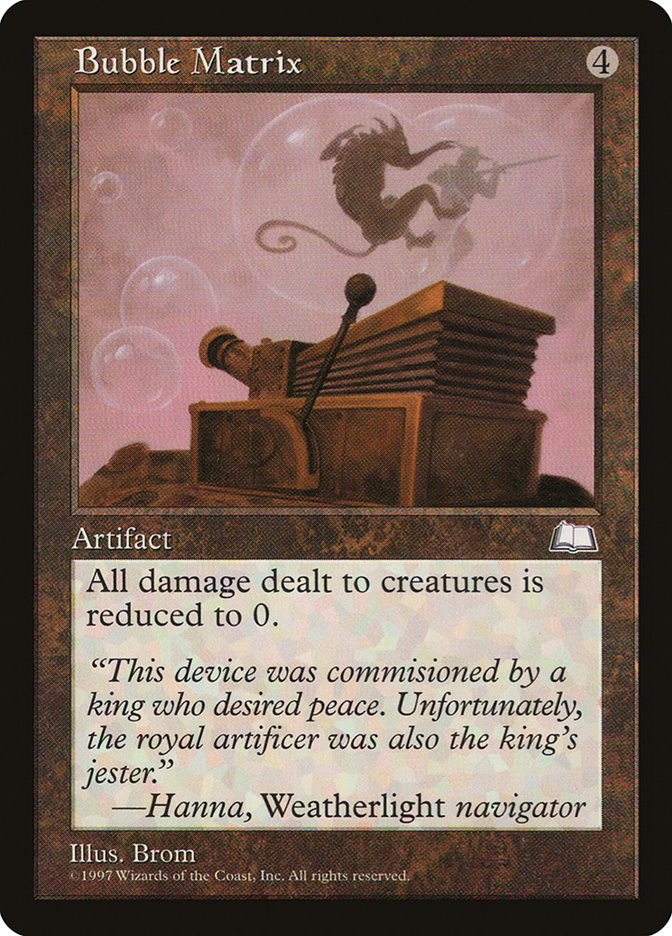
I’d like to talk to you today about a phenomenon I call the bubble effect. It pops up from time to time in Commander playgroups (well, any multiplayer play group really). It typically shows up when new players are joining the fold, but can even occur among established groups and total strangers. A player, for reasons we will dive into shortly, essentially ends up playing in a bubble, and manages to escape unscathed for most of the game or games you play together. This player is effectively in a protective bubble that allows them to hang around far longer than most players and make it to the end game state more often than not. This seeming Bubble Matrix occurs for many reasons, and they are not necessarily bad reasons. However, knowing and identifying when and where the bubble effect is occurring allows you to better evaluate its validity. In short, if you can correctly identify when the bubble effect is occurring you are able to determine when it’s best to burst that bouncing beeble’s bubble.

When the Bubble Effect is Best:

Everyone starts playing somewhere and somewhen. Whether you’re the kid that just picked up your first cards with the Commander Legends precons or you are the bigger kid that has been playing since Whitney Houston’s “I Will Always Love You” topped the pop charts in 1993, we all have a time that we started playing. When you first start playing, you can often find yourself losing and losing often. That is fine as long as you are playing among many other newbies. As a self-admitted “bigger-kid” who has been playing for decades, I try to enact the bubble effect for whoever is the newbie. This means that I try not to attack, pick-on, or otherwise hinder their development. I will keep them from winning if I must, and I won’t simply give them the game, but I don’t actively stomp them out early on. Why? Well, it means the newbie lives for longer. This allows them to develop as players. We all get better by gaining play experience.

I’ve watched my share of Magic matches, and that can help improve your play a little. However, nothing is a substitute for lived experience. The longer a newbie plays, engaging in the thought process of the game, the longer they are able to develop their play skills. They learn more cards, more tricks, more etiquette, and they get better all around. If that means they end up winning a few games here and there early on, then all the better! They will cherish these early bubble effect victories when the bubble bursts in the weeks or months to come. Eventually, they will have to claw, tooth and nail, for every kill and win they can get. In short, don’t curb stomp new players, but allow them to develop in a bubble of bliss. Once they are more experienced players, then you pop that bubble and crush them at the same time. It’s just the right thing to do.

Bubbles aren’t just for Newbies:

The bubble effect can occur amongst strangers and established play groups as well. Interestingly enough, they occur for the same reason. The reason is actually quite similar to the reason why the newbie gets to live in a blissful bubble while the table’s shark is often double-teamed early on. The bubble effect gets granted to the least threatening player at the table. This doesn’t mean the worst player is always in a bubble. If you sit down with Atraxa as your commander, then you can expect people might gun for you early on. You are instantly perceived as the most threatening player at the table. Meanwhile, the person sitting down with Nahiri, the Lithomancer as their general is often regarded as the least threatening (no Commander damage threat, and you’re playing mono-white). This can lead the “best player” at the table to be taken far less seriously, and as a result could even grant them a bubble. This happens because people want to have their last opponent be an easy kill, and are willing to risk their powerful spells in a bid to finish off the most threatening players. The idea is they trust that what they have left over is enough to crush the weakest looking player. This is a fine and often successful strategy. However, when the bubble player knows this and has planned for this, things may turn out differently from how everyone expects.  

Benefitting from the Bubble effect:

Imagine that you are the one who has planned to benefit from the bubble effect. Now, I bet you’re interested in hearing how playing a Commander like Nahiri, the Lithomancer is better than playing Atraxa. You can purposefully build an underwhelming Commander deck with an underwhelming commander in order to garner the bubble effect. Once you have your bubble, clinching the game in later turns is your goal. You just need to keep yourself alive long enough and not present yourself as too much of a threat. You can do this by keeping yourself from engaging in spell slinging wars with others until you are all trying to stop the main threat, or you are trying to shift the focus away from you. You preserve your resources as much as possible, and trust that an under-developed board state will lead you to living longer, thus enabling you to come from behind for the win. Let others do your dirty work. This is not a strategy for those seeking to win with the lion’s share of the kills while marching toward an epic victory. This strategy is for those that desire a sneaking, calculated approach to abuse people’s perceptions. So, enjoy whenever you can pull it off!

The finer points of Bubble making:

If you are attempting to build yourself a little bubble, then start with a non-threatening commander. Once you’ve done this, then you need to try and find a balance between solid cards, and game swinging spells. Generally, you will be winning off the backs of sub-par creatures or some other critical mass style of creatures using either enchantments, equipment, or pump spells. These tend to work best as having creatures that don’t present dramatic threats leaves you low on people’s to-kill lists. However, you also need to do your part in shifting the attention away from you and pointing out how dangerous other players are. This does not work if you are presenting yourself as a serious threat. Instead, you need to put dash of honesty in your distraction. You are concerned about other power-house players, and you need others to help you deal with them. Meanwhile, the power-house players aren’t going to target you since you’re the one begging for help. Generally, asking for help makes you look weak and therefore the ones you are asking for help become juicier targets. The alpha threat usually views you as the one they will deal with once they’ve killed off the ones you are begging help from. They figure that you wouldn’t be asking for help if you didn’t need it, and thus, you are the weakest one. Therefore, you will be the easiest to crush in the end. If you can manage to play the table with a combination of politics and slow building, then you are on your way to riding a bubble to victory!

When and How to Burst Bubbles:

I feel like I’m playing Bubble Bobble while writing this article. I’m asking you to put people in bubbles, use bubbles, and now burst those bubbles. The time to start bursting newbie bubbles is once they seem to be taking down a few too many games in a row. That shows you they are more than ready to feel everyone’s full might. The newbie will no longer be allowed to slide along unnoticed. This is a healthy time to burst the newbie bubble and allow them to become a regular. Meanwhile, the much more difficult bubble to burst is the one that someone is using to their benefit. The existence of this bubble is difficult to notice. Often we are far more focused on the opponent that is actively trying to win or who is the biggest and most immediate threat. One way to avoid falling into a bubble trap is to keep a close eye on people’s life totals and hand sizes. If you notice that someone has a grip full of cards, is deflecting attention away from themselves, and is trying to get people to take care of all the threats for them, then you just might a bubble to burst.

Once you notice the bubble it can be tempting to call attention to it. You may wish to blurt out to everyone that Mike is just creating a bubble effect, and if we don’t band to together and crush him, then he’s going to steal this win from all of us. I’ve tried it, and it doesn’t work out too well. You are often the crazy person who is just carrying some old vendetta, or if you are playing with strangers, then you’re the jerk who’s asking everyone to beat on the weakest player. Rather than play politics, you need to just begin applying a little pressure on that bubble. You don’t need to exert maximal effort to destroy the bubble blower, but you should begin to try and whittle away their answers and life total. By pressing them bit by bit you deny them the advantages they need to gain a late-game victory. Sure, you might find yourself in a bit of a battle, but remember that they likely won’t be able to kill you without first revealing what a threat they truly could become. That’s all you really need to do. Once you’ve exposed them, their bubble is burst, and perhaps you can now assume their old role. Or you could crush them along with everyone else!

Bubbles Bounce:

I didn’t bring up this topic to burst your bubbles. I want us to keep using the bubble effect. I think it’s great, and I think that if we recognize it more often we can all benefit from it. Allowing newbies to ride their bubbles until they are tenured is great. Allowing them to ride the bubble longer than they ought to is not. Once you recognize bubbles occurring in your Commander games, then you can choose if you wish to burst them or play along. Having that knowledge is important, and knowing what to do with that knowledge is even better. The most intriguing aspect about the bubble effect is that we can abuse it to meet our own ends, while still preserving it for the benefit of a new player’s long-term development. Now that you know how to recognize, abuse, and burst those bubbles, you should bounce yourselves into a game as soon as possible! 

If you enjoyed this article, then please consider subscribing to my blog. Subscribing will send new articles directly to your inbox. You won’t have to check back to read any fun new Magictations. Thanks for reading!

Kills, Wins, Glory, and Pride. 

A Magictation by Mikeal Basile

“Magictating” is defined as getting into the zone with your Magic the Gathering collection–thinking, planning, organizing, reminiscing about past games, and imagining future games. It is a combination of hard thinking about the game and calm meditation, reveling in the joy it brings you.

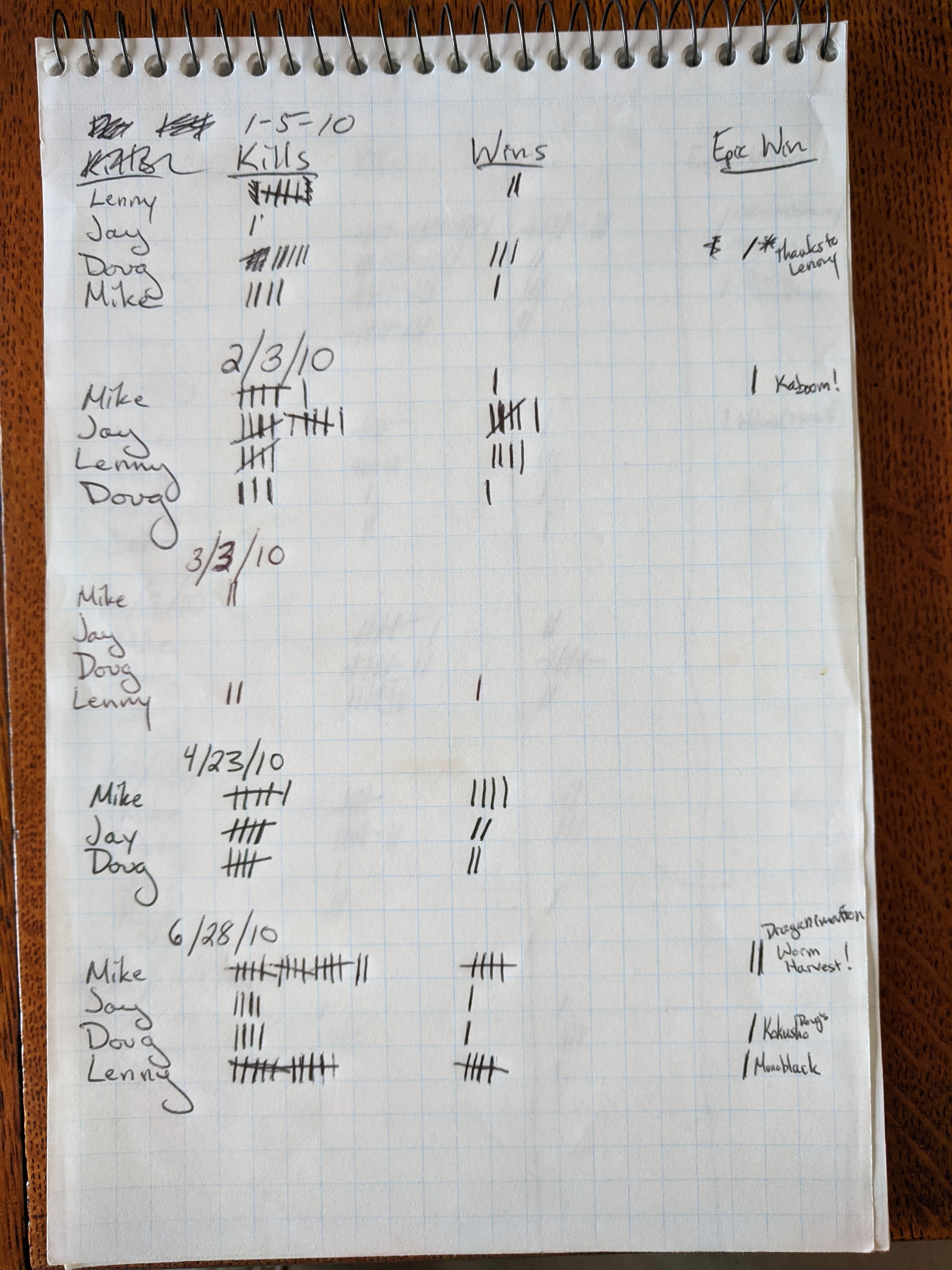
I used to be able to trash talk how often I won games like Yahtzee and Rummy against my wife. I use the past tense, because she started keeping a record book to prove to me that my win percentages were anything but brag worthy. As it turns out, though not a surprise after 15 years together, she was right. She took to labeling the winner: “Champion” and the loser (only when I lost) the “Hunted Wumpus”. She crushes me, routinely. Thank goodness she never picked up playing Magic–I can still say I am the best Magic player in the house. I decided that the record book was a great idea, and so The Kills Book  was born. What is The Kills Book you ask, well it is a piece of living history. Aside from keeping track of how many times you’ve defeated your foolish foes, I mean friends, it serves many other useful purposes.

The Kills Book records the names of players, the dates we play, number of kills, and wins earned for each gaming session. For cube drafting days I also record draft records and deck archetypes. It is important to record a variety of information, but I did not want this to become some Sisyphean task. The date, names, kills, and wins is OK, but Commander players need something a little grander. Hence, I have an EPIC WINS column. Epic wins involve four or more players, and require the winner to have dealt the fatal blow to all three opponents. To properly honor a win of this magnitude the deck’s name is recorded next to each epic win check mark.

What other purposes, aside from wins recorded, does a kills book serve?

The Kills Book offers people pride, honor, glory, and a place in the annals of local Magic history. It is not all about recording total wins. The Kills Book does not care about your all-time wins or even your all-time kills. Each gaming session stands on its own. This makes each session even more special. Killing someone and earning a tally mark each session is a point of pride. Even if you lose every game that day, you at least walk away with the pride of having taken out someone else first. Each tally mark on the day is a way to inch closer toward the honor of Championship status. After all, no one wants to be the shameful Hunted Wumpus (no kills). Keeping each session recorded by its date allows one to better reminisce on the history embedded in past gaming sessions. As an example, let us analyze a page from the book and see what memories it dredges up.

January Games:

This was nearly ten years ago, and I remember that January 5th gaming session better than most other things that happened a decade ago. In particular, I vividly remember Lenny allowing Doug to take the Epic win, by hosing me. 

Lenny removed my graveyard from the game in response to me targeting  my Akroma, Angel of Wrath with Miraculous Recovery. He could have used his Tormod’s Crypt to exile Doug’s graveyard (he was playing a clone style deck with Kokusho, the Evening Star and Keiga, the Tide Star. When I asked him if he was sure he wanted to target me, his response was clear, “I want to see Doug’s deck get an Epic win by doing its thing.” I was tapped out, and I had no other plays. I had no outs, and Doug was surely going to go off next turn. Yes, Lenny wanted to see Doug get the glorious Epic win, and so everyone (except me) got what they wanted. The Kills Book, and the coveted glory of the epic win, made this possible. Would Lenny have been less likely to have allowed Doug’s deck to get the win? Well, I asked him, and he totally wanted Doug (or anyone but me) to get that first Epic win. 

Additionally, I distinctly remember Jay killing off Doug when he was mana screwed in one of our games that session. Why? Jay wanted to record his first kill for the day, and Doug was accepting of being killed off early, because it was clear Jay needed that tally mark—he was almost the dreaded “Hunted Wumpus”. Clearly, The Kills Book helps foster an environment that eliminates board stalls. Recording kills can be just as satisfying as winning games. Maneuvering for epic wins is yet another element to peoples’ overall strategies. Do not underestimate the desire to achieve glorious epic wins, and rabid fascination of avoiding the shameful title of Hunted Wumpus.  

February Games:

These games took place over the course of a twelve hour Magic marathon day. We started at around 8am, and played until 11pm. It was glorious. We played thirteen games of Magic that day. I even recorded my first Epic win with my old multiplayer monstrosity, The Kaboom! Deck. That was a thing of beauty. I distinctly remember setting up the kill by gauging everyone’s life total, stacking my deck with Riddle of Lightning, and doing 16 points of damage to Jay on his end step by revealing Draco. Then, on my upkeep, I spun Sensei’s Divining Top. I drew a land, spun the top, then cast Kaboom!. I did 16 (Draco) to Doug, 14 (Blinkmoth Infusion) to Lenny, and 5 (Kaboom!) to Jay. I would never have remembered that with such clarity if it were not for the record keeping help of The Kills Book. This is just one example of many stories I can recount of that day’s Magic games.

June Games:

I find myself remembering the first real day of Summer Vacation. Doug’s Kokusho Deck got another epic win. Then Lenny’s Monoblack snuffed us out to score him an epic win, and I snagged two epic victories using two of my old multiplayer decks, Draganimation and Worm Harvest. Lenny brutalized us with massive swamps matter spells, like Nightmare, Mutilate, and Korlash Heir to Blackblade. I remember casting Victimize by sacrificing Bladewing’s Thrall to return Dragon Tyrant and Bladewing the Risen. The Thrall got to join the party again. Meanwhile, I used Bladewing the Risen’s trigger to return Karthus, Tyrant of Jund, and then I proceeded to win target game. 

The other epic win I pulled off was with my Wurm Harvest Deck. I used Invasion sacrifice lands, and weaker cycling lands as well to fill my yard with Wurm Harvest fodder. I then dredged up Dakmor Salvage several times to recast Wurm Harvest, cycled a few more lands, then drew a game ending Overrun–epic win complete!

Hunger Games:

Those were glorious days, and reading over these notes gives me such a wonderful feeling of nostalgia. The Kills Book creates honorable moments, gloriously epic victories, and a place to look back and remember how we all grew closer together, by crushing one another in Magic the Gathering. The organic living history of our Magic gatherings is really a wonderful thing to behold. Each playgroup needs to keep one of these. Adding to it makes every game night a part of your organic saga. Being able to look back on your friend’s successes and your own crushing defeats can be surprisingly enjoyable. Keeping this living history going is actually simple. The Kills Book creates a hunger for more tally marks, and your friends will be asking you not only to bring it, but to keep it as accurate as possible.  

It sounds like a nice idea, but I’m overwhelmed. How do I even start?

You start by getting a notebook. I chose a simple Steno Pad, because it is easily portable, and easily storable. It is bound, so the pages will not fall out, and I had one handy. You may opt for anything from a leather-bound journal to napkins sewn together with yarn. Once you have a notebook, outline the criteria you wish to record. I suggest keeping each play session as a separate entry. You can use mine as an example, but do not feel like you must keep to my methods. Feel free to include snacks you had, amazing plays that were made, or even new cards that were showcased! If you feel like this is too much, then just keep to recording kills, wins, and epic wins. You can change the criteria for an epic win to whatever your playgroup defines it to be. Perhaps you feel epic wins only occur when someone’s deck wins by “doing its thing”, as Lenny so graciously decided Doug’s deck should. I am not bitter…I am simply recalling the phrasing that preceded my loss and Doug’s epic win (yes, I am still salty). Once you have the criteria recorded, then I suggest you keep the book with your decks. This ensures you never forget to bust out The Kills Book. Nothing makes a gaming session feel more official than the opportunity to add to the living history you and your friends are recording each and every time you sit down to destroy one another. 

Parting Thoughts:

I have been keeping The Kills Book for nearly a decade. I love this thing, and my biggest regrets I have about it are not recording every single game in it. There were days I forgot to bring it to a friend’s house. There were days I left it in my cabinet, and others where I just forgot to record it as we were playing. However, I have managed to capture most of my play sessions with it, and it is something that has brought me far more joy than any other record keeping I have ever done. It helps move games along and eliminate board stall. It helps give people pride when they lose the match, and can bring a whole new quest for glory to those of us with a desire to record every kill. You need a Kills Book whether you are players just starting or original gamers from the ABU era. The Kills Book is simple to keep, but pays major dividends. Does your playgroup keep one already? I would love to know what you record in yours. 

Unwarranted Backlash for The Secret Lair X The Walking Dead

A Magictation by Mikeal Basile

“Magictating” is defined as getting into the zone with your Magic the Gathering collection–thinking, planning, organizing, reminiscing about past games, and imagining future games. It is a combination of hard thinking about the game and calm meditation, reveling in the joy it brings you.

I don’t know if you’ve noticed the furor that has developed over the Secret Lair X The Walking Dead, but it is unwarranted. I feel that this outcry is both misguided and absurd. As these cards will be legal in my format of choice—Commander—it is my duty to provide people with some perspective and guidance. The arguments being made do not warrant this sort of outrage. The new Secret Lair drop, for those of you that are unaware, will include mechanically unique cards, and the names and artwork are The Walking Dead characters. I do have other issues with Secret Lair in general, but I will address those last. For now, let us dive into why people should not view this as something catastrophically bad.

Commander players need to calm down, stop being upset, and see this latest Secret Lair Drop as the small limited set that it is. There are plenty of other things going on in the Magicverse, and focusing your energies on The Walking Dead being featured on black bordered Magic: the Gathering cards is definitely not something to spend your energy on. The issue people seem to have with this Secret Lair Drop is that it is a limited edition (like all of these things). People are concerned that Wizards will be unable to reprint these cards again, because they will only have copyright access for a limited time. If this upsets you, then please, relax. Wizards can simply do a functional reprint of any of these cards at any given time. Furthermore, they may even be able to do the Ikoria subtitle Godzilla treatment. Sure, the names and artwork might not be the same, but the functionality of the card will be identical. It could cause issues by giving people multiples of a single card, once they are functionally reprinted, but we are far away from that scenario. I’m not convinced that these are overpowered cards in Commander, and therefore the call for a ban because something is too collectible is just absurd.

Magic: The Gathering is the original collectible trading card game (CCG). The first “C” means that the cards should have value. These are not merely game pieces, and to view them as such is a disservice to the game itself. It destroys the integrity and mystique of the game. I have seen people referencing Nalathni Dragon as an example of what happens when Wizards makes cards that are too rare. I remember the Nalathni dragon incident, and even as young kid who could never afford one, I thought it was awesome. The existence of a card that was beyond my reach made me feel like this was a game that had depth and value. Wizards had given them out at Dragon Con, and until it showed up in a magazine promo a few months later, it was the hottest card around. Everyone wanted one, and not everyone could get one. It is OK not to be able to afford every card in the game. This is even more true when playing at a recreational and non-tournament level—Commander. Nalathni Dragon wasn’t even overpowered at the time, but it was really rare. Honestly, I get the comparison between the two, as these Walking Dead cards do have the potential to be like Nalathni Dragon.  Yet, Nalathni Dragon was a great talking point and a collector’s target. It is not a bad thing for a collectible game to have rare items. By definition the game needs items that are “chase” pieces. 

Furthermore, The Walking Dead cards are not overpowered for Commander purposes, and they will most likely become interesting odd-ball cards that show up at the kitchen table from time to time. Even if they end up being expensive, that will simply be a result of supply and demand. I’m leaning toward them becoming odd-balls and forgotten after a year or so. Sure, it’s hard to predict, but ultimately the way it shakes out is all part of having a collectible game. If these were grossly over-powered this would be a different conversation, but these cards are not Commander pushed. They are fun collectibles, and should be viewed as such.

People are calling for these cards to be banned from the Commander format. Seriously? I was shocked when I read it. I was perturbed when I found strings of people piling on about this. I was disturbed to find influencers agreeing with this. There are reasons not to want to support Secret Lairs, but this rationale falls short of anything rational. Rather than calling for a ban or griping about the potential limited nature, or more accurately the highly collectible nature of these cards, we should be voting with our wallets instead. If you do not support these cards, then do not buy them. Just because you think something might price you out, calling for a ban is not warranted. I think the Magic community forgets that this is one of the best parts of being in a free market economy. We get to vote every single day. We vote on what products we support by buying those products. When we skip sets, releases, or other events, we are letting Wizards and our local gaming shops know that we do not support a product. When you want something banned, then it should be for play, and not monetary reasons. This is especially true when dealing with a casual format, or as many like to say—The Casual Format aka Commander. So we may find that this product does not sell well, and when supply is low and demand is high the price goes up. Or, perhaps they tank completely as no one wants them. I’m inclined to think that they will be fun to play with, but not any more fun than the latest Commander cards from any given set. 

If you are a collector, then you are probably going to pick up one of these. If you are a player, then you are deciding how fun these might be to play with, and if they are worth the investment. If you are a Walking Dead fan, then I’m sure you will be looking to pick these up. I am not a fan of The Walking Dead, but that is really because I find the whole zombie trope (great unwashed and uneducated masses yearning to devour the intellect of others only to spread more ignorance) a bit tired. Otherwise, I might pick this up just to try playing with some of the mechanically unique cards. I guess it depends on price point and how much you are willing to spend on five new cards. As with any product, you evaluate what you want and what you get and base your decisions on wants vs. needs.

The gripe about these cards being legal is simply not warranted. These are not even close to as powerful as the new Omnath or really any of the new powerful Mythics from Zendikar Rising. Wizards has been printing broken cards left and right in standard sets! If you have $60 to spend on Magic, then you would probably be better served buying some sweet new singles from your local gaming store. Have you seriously looked at Zendikar Rising’s cards? They are very powerful, and super splashy for Commander. The Walking Dead cards are really just a flash in the pan. Since it is a Secret Lair, people are letting their “fear of missing out” overrule logical reasoning. Commander should never be viewe as a format with “must-have” or “must-include” cards. That attitude and approach is in direct opposition to the very spirit of this format. The restrictions Commander requires are there to help you be a more creative and more fun deck builder. We should not be trying to homogenize Commander decks into finely tuned archetypes. This Secret Lair Drop is a neat little experiment, and if the loudest among us have their way, then we may not see other interesting non-Magicverse cards showing up in Magic: the Gathering. As a guy that loves Magic among other geeky endeavors, I hope this is not the case. I would love to see TMNT cards, but if Wizards listens to this ridiculousness that may never happen.

Some people have been calling for these to be printed in the Ikoria fashion. Magic card names subtitled beneath the Walking Dead names. That could have very well worked. I assume they did not do that, because they are experimenting with other IPs (intellectual properties). I find this experiment to be interesting. I am interested in not only the collectability of these types of cards, but how they might add a different feel to someone’s deck. It allows you to lean into a particular build or flesh out your own story that may not necessarily be Magicverse centric. I think that is a fine thing, but I may be part of a quieter crowd. I would not mind if these were printed as some sort of Future Shifted concept cards, and that someday they may be reprinted in a fitting set. That would be fine. However, the way it is being done currently is just fine.

The majority of the outrage seems to be focused on the potential for limited supply, which I have discussed, and the idea that selling these is somehow predatory. That word choice is simply absurd. The oversimplification and the name-calling needs to stop. This is more a perspective issue than a supply and demand issue. I fear that far too many Magic players, or at least far too many vocal magic players, believe that Magic is simply a game with game pieces. I am going to be unpopular perhaps, but that’s something I’m used to since I played Magic: the Gathering in the ’90s. Magic cards are collectible trading cards. It is the original CCG. Collectible card games, by definition, need to have some cards worth more than others. I know we should all know this because every card is printed with a set symbol and that set symbol has been color coded for a very long time. The color coding of the set symbols corresponds with the rarities. While it doesn’t always shake out to be exactly correlative to the prices, the rare/mythic cards tend to be more expensive. When we extend this thinking to foils and alternative printings, then we can see supply and demand determine the prices of cards. This is why when a mythic rare is desirable in every format in Magic, the price of that card tends to skyrocket. Will the price of these The Walking Dead cards skyrocket? Well if I could predict that, then I would not waste my time writing about it, and would instead make millions by buying them all. Seriously, though, it is totally fine to not own every single item that Wizard’s makes. There are over 20,000 unique cards in Magic, and this is not Pokemon. You do not need to catch them all, and you can play without owning every card. Commander is a format that thrives best when people dig through their collections and utilize cards that have been collecting dust for years. 

Is there a legitimate reason for Commander players to be upset about The Walking Dead Secret Lair drop? Yes, but not what you might think. The real problem is that these cards are sold directly by Wizards. Cutting out the middle man might be a good business practice for business owners. However, with Magic you are cutting out the very people that enable your buying base to help exist and play the game. The issue with Secret Lair stems from undercutting your local game store. These products are not a way for your LGS to make money, but at least the big box stores are left out too. I personally wish that I could order these Secret Lairs from my local game store. I wish my LGS was the go-between for these products, or that they had access to them at a discount they could then pass on to me. However, that is not the case. If you believe in supporting your local game store at all costs, then you have already made your decision about The Walking Dead cards: hard pass. You will continue to pass on every single Secret Lair drop, because you cannot order from your LGS. I respect that decision. I admire it.

I wish you the best in your own decision making process over the next several days. However, I urge you to seriously consider why cards should be banned, and others unbanned. The rules committee for Commander made the right choice. They did not ban cards that are not problematic for play. They did not cave to cancel culture and its irrational cries. Use the Commander Rules Committee’s rulings as guidelines for playing with new people. You can abide by the rules with your regulars or choose not to. That’s the beauty of House-Rules. Heck, I play a deck with Chaos Orb, because my hour-rules say it is legal. However, if I come to your house, and you tell me my Forcefield is banned, because they are too hard to get, then I am taking my ball and going home. Banning cards because they are expensive is a horrifically slippery slope. I do not support that at all. So, remember to vote with your wallet, make decisions rationally, and play Commander to crush your enemies—I mean friends. 

Spicy Reserves on a Budget

A Magictation by Mikeal Basile

“Magictating” is defined as getting into the zone with your Magic the Gathering collection–thinking, planning, organizing, reminiscing about past games, and imagining future games. It is a combination of hard thinking about the game and calm meditation, reveling in the joy it brings you.

A Hidden Spice Drawer:

There is a thing called the reserved list, and if you do not know what I mean by that, then I suggest you read up on it later. The reserved list, to put it simply, is a list of older cards Wizards has promised not to reprint. This exists so players can feel free to buy and collect older cards, knowing those card’s values will not plummet from a reprint anytime soon. There is a debate about whether it should exist or not, but I am not weighing in on that today. No, today I want to use this list to show you how much spicy Commander goodness lurks within it for under $5. You read that correctly. I am talking about cards, rares mind you, that are promised not to be reprinted, and are still under $5. There is something here for every player, so let us get to unlocking this particularly savory spice rack.

Wave of Terror

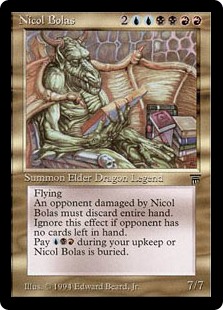
Wave of Terror is such a wonderfully named card. People quake with fear when it is cast. The upkeep age counter goes on first, so it will not hit tokens, but the slaughter gets ramped up faster this way. Each upkeep you send wave after wave of terror washing over the battlefield. The casualties just keep piling up. You could potentially use this to keep tokens in check by using either Clockspinning or my favorite token eater, Chisei, Heart of Oceans. Give in to your inner Nicol, Bolas, and use Wave of Terror to put your foolish enemies to a permanent rest.

Rainbow Efreet

Blue has many cards that could be considered tricky, but this original Draw-Go win condition has been forgotten. For blue decks, Rainbow Efreet was the original unkillable creature. It dodges instant and sorcery removal of all kinds–targeted or sweeper. Rainbow Efreet simply leaves the game and comes back swinging on your next turn. I remember winning games by activating my Nevinyral’s Disk, on my opponent’s end step, and phasing out Rainbow Efreet in response. The beatdown that this beautiful little monster delivers is not to be underestimated. Remember that equipment and auras attached to Rainbow Efreet stay with it as it phases in and out. This is one Rainbow that does not promise hope for your opponents. 

Subterranean Spirit

Subterranean Spirit is criminally underutilized. I know that a five mana 3/3 is not very exciting. Adding protection from red is mildly interesting. Yet, adding the ability to tap for a Tremor effect is pretty sweet. It is immune to the damage it deals, as it has protection from red. You can use this keep Pyrohemia around no matter how much damage you dish out, or have something left over after a massive Earthquake. Subterranean Spirit can help do some work controlling small token generating strategies, but I want to break it a little too. I love the idea of using this with equipment like Gorgon Flail, Gorgon’s Head, Basilisk Collar, and Quietus Spike. Enchanting this with things like Charisma, or Aspect of Gorgon is also fun. Tapping Subterranean Spirit to wipe out or steal every creature on the board seems pretty amazing. Who does not enjoy killing everyone’s creatures with some fiery card that has not seen print since 1996?

Natural Balance

Natural Balance is seems to go against what green wants to do. This allows you to take advantage of other people’s ramp. This works great in decks that rely on artifact ramp, rather than land ramp. Having ways to sacrifice your lands or play them from the graveyard only makes this better. The Gitrog Monster is a commander that would benefit from this ambrosial include. Natural Balance helps tone down other people’s threat potentials while ensuring you keep your lands flowing. This is a great card to pass around the table. While your opponents are binning their extra lands, you can rest easy knowing those battle-cruiser cards are going to stay out of play for a few more turns. 

Abeyance

Before there was Silence, there was Orim’s Chant, and before Orim’s chant there was Abeyance. Abeyance is a great “gotcha” card. However, I love Abeyance best of all those gotcha cards because of its ability to replace itself. It can essentially be cycled, but with a fantastic upside. Combining this with Isochron Scepter and Seedborn Muse is clearly the dream. Being able to draw a card on each opponent’s turn and not allow those opponents to ever cast instants or sorcery spells is ridiculously good. This can also be great against free spell commanders like Joira and Narset. Sure, they can exile those cards or think about casting them, but Abeyance says, “NO SPELLS FOR YOU!”

Powder Keg

Powder Keg was once a tournament sideboard staple. Now it is a forgotten relic, so why not bring it back? This wrecks tokens for a mere two mana, and can be built up to deal with most early and mid-game threats. It also hits artifacts, and that can be a great way to clean up Sol Rings or the increasing number of two mana cost artifacts that tap for mana. If you have friends that are abusing mana rocks and overpopulating the battlefield, then it is time to blow up everything with Powder Keg

Unfulfilled Desires

Unfulfilled Desires is a misnomer in any decent reanimator deck. Gyruda Doom of Depths decks will love this card! This enchantment fills your graveyard with your darkest dreams. Paying one mana and one life to loot at will is an excellent rate. The card selection this offers is ridiculous. Drawing and discarding at instant speed with any left over mana–every single turn–is an incredible way to get ahead of your opponents. This enchantment allows you to easily dump your creatures into your graveyard while digging you into the reanimation spells you need. Additionally, this is a good draw early on, and it is still a solid top deck in the late game. If you draw it later on, then you can pump loads of mana into it to dig down to that game-winning card. Fulfill your most vile needs, and keep your opponents guessing with the zesty include that is Unfulfilled Desires.

Circle of Despair

Circle of Despair is another multicolored reserve list spice that offers a very powerful effect. This is an amazingly powerful sacrifice outlet in Aristocratic and other sacrifice oriented decks. These decks need repeatable sacrifice outlets, and this one is harder to kill than the average creature. Additionally, this enchantment gives you the ability to play politics. You can easily make an alliance early on by sacrificing a few tokens to help someone else stay alive. Circle of Despair’s ability, much like the original Circles of Protection, does not target. This allows you to prevent damage from a hexproofed, trampling, unblockable, double-striking, 12/12 commander. There is no “one-shotting” you with commander damage as long as you have a creature to sacrifice to the Circle of Despair. Coupling this with token generators like Sacred Mesa or an Elspeth (just about any of them) puts you in a fantastic position. I love the idea of putting this into an Ayli, Eternal Pilgrim deck (creature type cleric for those excited about the new Zendikar party mechanics). 

Closing Thoughts:

Those are the most interesting and exciting cards you can find on the reserve list for under $5. There are other interesting cards there too, but they do not offer the same distinctive effects as these. I love being able to play a card that most people are not aware existed. It has always been a joy of mine to pass my spicy cards around the table for everyone to appreciate their zesty effects. The reserved list has become a contentious item lately, but it still exists, and so why not take advantage of it as a budget collector? The cards on the list are all older, and so their effects tend to be odd or strange. The reserved list can function as a short-list for unique and underutilized cards. So what are you waiting for? Go pick up some new spicy cards to jank out friends!

Buy lands, Not Spells

A Magictation by Mikeal Basile

“Magictating” is defined as getting into the zone with your Magic the Gathering collection–thinking, planning, organizing, reminiscing about past games, and imagining future games. It is a combination of hard thinking about the game and calm meditation, reveling in the joy it brings you.

As Zendikar Rising is set to release in a few weeks, and it explores lands, I am going to explore the best lands for my fellow Commander players. Lands are the resources that provide the drama in Magic. So many games hinge on mana–how much you have and what colors you can access. As a Magic player, you should invest in the best mana base for your deck. When you are a Commander player, you should prioritize lands above almost everything else. Your format does not rotate, and so your rare lands will always be playable. Nothing is more fun than casting your amazing and incredible Commander spells. However, you cannot cast incredible spells like Last Stand with a shoddy mana base. You cannot cast anything consistently without a well-tuned mana base. In short, you must buy the best lands for your budget. 

Which lands are the best?

Basic lands are the best lands. They always come into play untapped. There is very little hate printed toward them, and they are practically free. If you want the best lands for multi-color Magic decks, well, now we have something to explore.

The original dual lands from Magic are the best. They check all three boxes–basic land types, come into play untapped, and incredibly expensive to purchase. Oops, wait, they are not budget friendly. I would still contest that, as a Commander player, it is still worth picking up a dual in your favorite color combination. It will never disappoint you, and it will always bring you closer to victory.  

For the budget conscious, there is a vastly more affordable option in the Ravnica shock lands. These actually check all three boxes: basic lands types, can come into play untapped, and mostly budget friendly. The Ravnica shock lands require you to pay 2 life to have them come into play untapped. Commander does start with 40 life, so this is not too large of a drawback. Currently, there is nothing that comes in this close to the original dual lands. Plus, you can pick up all 10 for around $100! 

The Amonkhet lag lands or bicycling lands are just OK (bi=two, cycling because they cycle, sigh). These lands come into play tapped, so that is not good, but they do have basic land types, and they are super affordable. They are inferior, so that is why they are cheap. I would recommend you pick up the set, because they have the basic land types, and they are super cheap.

The Ikoria Triomes are also guilty of the same sins as the Amonkhet lands, but at least they provide three different colors. It is hard to find a land that provides three different colors that does not come into play tapped. These lands are, as of this moment, perhaps the best budget land on the market. 

Why do basic land types matter on non-basic lands?

Fetch lands are pricey, but they are really good with duals. Fetch lands make your mana base so much smoother. You have more choices for lands to fetch, and dual lands with basic land types on them are amazing to have in a deck with fetch lands. If dual lands did not exist, then fetch lands would be inexpensive. Once you own a few dual lands, of any type, you need to prioritize buying fetch lands. If you are budget conscious, then might I suggest picking up the vastly more affordable, though slightly slower, Mirage fetchlands? They work best with the original duals and the shock lands as you can have them come into play untapped. However, if you are desperate for mana fixing, then perhaps you could fetch a tapped bicycling land or even a Triome. If you are in the correct colors, then you can even take advantage of Krosan Verge as a sort of super fetch land.

Are there more budget lands that I can’t fetch?

There are many options for lands that do not contain basic land types. The other two boxes we need to check would be coming into play untapped, and being affordable. 

The Battlebond lands are also good at what they do, but they are a bit pricier. If you can afford them, then you should probably pick them up. They are actually amazing in multiplayer and feel incredibly close to playing an actual dual land. They are not fetchable, but if you do not own fetches, then these do a good impersonation of a dual land for most Commander games. 

Magic also printed some interesting check lands. These lands come into play untapped if you have a basic land type they produce already in play. These are good, cheap, and usually enter untapped. What are you waiting for? Put them in your decks.  

If you cannot afford duals or expensive fetch lands, then I suggest you pick up a few of Clubber Lang’s favorite lands: PAIN LANDS. The pain land cycle, which began in Ice Age and finished in Apocalypse, are excellent mana sources. You can tap them for colorless mana when you do not need color, and then allow you to take a point of damage to get the color you need. These tend to shine in decks that have plenty of basics. You use them for color when necessary, and then keep them as colorless filler later on. 

The filter lands from Shadowmoor help to smooth out mana bases too, but also require that you have colored mana to activate them. The Odyssey filter lands do not require colored mana, but lack the mana options provided by their Shadowmoor counterparts. These are fairly equal in terms of playability, and really depend on your deck’s casting costs. However, they are both excellent budget options. 

The Ravnica bounce lands are where you start to dip into the comes-into-play tapped variety of budget dual lands. They are deceptively good, as they allow you to get an extra land drop by returning your land to your hand. They also tap for two mana each, so they have a significant pay-off for their downside. There is no reason you should not own at least one of each (I might own thirty of each). 

Man lands from Worldwake offer another great payoff for their tapped downside. These lands smooth things out and offer a body when you might need one. These have fluctuated in price over the years, but they seem relatively cheap now, so pick them up and be happy about it. While you’re at it, check out the completion of the cycle that was printed in Oath of the Gatewatch.

The temples are super cheap, come into play tapped, but give you a quick scry. These are fine lands. They are cheap monetarily, and they give you a little reward for the pain of having them come into play tapped. I do not love these in Commander, but they are serviceable and budget friendly. 

The common gain lands from Khans block offer the best and cheapest option. They come into play tapped, gain you a life, and then function just like a regular dual. They are not fetchable, but they are cheap. I would caution you against running too many lands that come into play tapped, so just keep that in mind (less than 25% is ideal).

Wait, isn’t there anything cheaper?

Do you want something for nothing? Well, then I guess you should check out a few other odd ball lands. Tempest and Champions of Kamigawa have a series of lands that can tap for colorless or when they are tapped for colored mana do not untap the following turn. These are actually an improvement over the Ice Age lands that did the same thing with depletion counters, but did not have the option of tapping for colorless. I ran Land Cap in my blue white deck, and it was the best I could get until Homelands gave me tri-lands. It was a rough time for mana options outside the original duals. 

The next best option to using duals is using fetch lands with basic lands. This does not mean you have to have Prismatic Vista (though it is the best at doing this). There is also Fabled Passage. If you want better budget options, then I highly suggest Terramorphic Expanse and Evolving Wilds. Beyond that obvious pair lurks the often forgotten Panoramas from Shards of Alara. These fetches allow you searchable access to three different land types. In addition, you might consider Terminal Moraine and Warped Landscape for fetching basics. 

What about these new dual lands they spoiled?

I did not see any dual lands. Oh, those flip lands? Those are not dual lands. You cannot search for them, and they can only tap for the mana on the side you play it. At least they come into play untapped. I am a little surprised they are rares, but perhaps I am undervaluing them? I suspect they were made rares for drafting purposes, and not because they really stand up in any sort of modern rare land comparison. They really will function like a fetchland, but will lack the time-consuming searching and shuffling process. You will have to choose when you play it what type of mana you want from it. There are ways to reset the lands and either blink them or replay them after bouncing them with a Golgari Rot Farm, but they will usually just stay how they are played. I love that they come into play untapped, and that they allow you access the color you most need, at the moment you play it. I would play these over just about every other land that comes into play tapped. However, if I am running a deck with fetchlands, then these are inferior to fetchable options. These will usually provide an easy upgrade to a basic land you planned on including. Overall, these are probably worth picking up, but I cannot see paying overly much for them.

How do I prioritize what lands to buy?

I can tell you that you should decide which deck is your favorite, and start getting the best lands for that deck. Starting with a deck you already enjoy, and making it able to consistently cast all of its spells on-curve, is truly blissful. I love being able to cast my favorite spells the turn I draw them. It is awful when you need just one more color. Then, you draw a land, but you have to wait another turn, because your land comes into play tapped. Aargh! It only gets worse when someone casts Windfall while you are waiting (I speak from multiple experiences). Having a few lands that come into play tapped is fine, but make certain you are getting a good deal for what you are sacrificing.

Final Stand on Lands

There are other lands that I did not discuss, but I am out of time and space today. I am certain more Zendikar Rising spoilers will come, and with them more lands. I will take this opportunity to explain a few more ideas about which lands to play and which to avoid. Lands are often neglected by players. Decks are built with spells, and then we just find lands to toss in. While the deck does determine the lands we choose, the lands determine how well the deck plays. If you have an amazing five color deck, but your mana base is off, then you are not going to be playing much of anything. Do not suffer from color screw. Get yourself the lands you deserve, and make your decks the finely tuned machines they deserve to be. Crush your opponents, and make it all possible with mana that never lets you down. 

If you haven’t already done so, then please consider subscribing to my blog. It delivers my articles straight to your inbox for easy reading, and it helps me stay motivated to bring you all the best content I can. It is a free way to help support me and grow our Magitating community. Thank you so much, and feel free to leave any comments or suggestions below!

TAKING A SHINE TO SHRINES by Mikeal Basile

Commander Deck List and Deck Tech

A Magictation by Mikeal Basile

“Magictating” is defined as getting into the zone with your Magic the Gathering collection–thinking, planning, organizing, reminiscing about past games, and imagining future games. It is a combination of hard thinking about the game and calm meditation, reveling in the joy it brings you.

Inspiration:

I used to have many sixty card multiplayer decks. One of those decks was based on Hondens, and another one was based on Arboria. When new shrines were printed in M21, I knew I wanted to combine ideas from both decks to create something new for Commander. I just love the idea of making a dangerous pilgrimage into the late game, and then winning with my holy shrines. The deck needs a five color commander, and while Golos, Tireless Pilgrim’s name seems to fit the idea of the deck, I wanted to utilize Sisay, Weatherlight Captain’s ability to pull shrines from the deck and put those shrines directly into play. Playing a five color deck is one of my favorite things to do, and winning without creatures can be sublimely satisfying.

Check out the deck list HERE.

Notable Synergies/Combos:

This deck is loaded with cards that work well with one another. The shrines stack well together, but this deck dives a bit deeper. Many of these enchantments just serve to slowly tighten the screws and make my opponents unable to reach me from my privileged position [add link to Privileged Position card here too]. This deck takes some divine turns, and it helps to analyze some of its synergies and combos. 

Enchanted Evening and Calming Verse blow up everyone else’s permanents, so that often provides instant scoops from the table. If you are a fan of this interaction, then consider adding Cleansing Meditation. You could also consider adding Aura Thief and killing it with a Honden of Infinite Rage activation, thus stealing everyone’s permanents (gross, right?). I opted not to include Aura Thief, as thievery does not strike me as an acceptable practice for a holy shrines deck . 

Arboria has long been a card I enjoy playing. Leyline of Anticipation, Vedalkan Orrery, and Sisay all work with Arboria. Once you have enough lands in play, you choose to play cards only on your opponent’s turns. This lets you maximize Arboria’s protection. Other players may take advantage of Arboria, and that is fine, because this deck wins with shrines! Be careful when you play Arboria, as it is a World enchantment, and if you play Cavern’s of Despair after it is already in play, then you must discard Arboria (whichever World enchantment is newest gets to stay). 

Paradox Haze is great to keep the old fashioned Hondens cranking out extra value. Use Copy Enchantment on Paradox Haze to double the righteous activations! Do not try to copy a Legendary or World Enchantment, because that would be sad. 

Dream Tides combines sublimely well with Kismet, Frozen Aether, and Sanctum of Tranquil Light. This will wreck any green deck, and give all other creature-based decks absolute fits. Your opponents’ board development will be so stalled, that you are sure to make it to the late game. Shrines shine in the late game.

Pendral Mists taxes creatures and stalls development. It helps to make every other taxing effect in the deck even stronger. I have cast Copy Enchantment targeting this, and it makes life miserable for creature decks. 

While playing this deck, I am often heard saying, “You cannot attack me unless…” The Propaganda-style enchantments all stack on each other, so if you resolve a Ghostly Prison and a Sphere of Safety, I doubt anyone is attacking you anytime soon. Being able to toss Copy Enchantment on something like Collective Restraint is just gross. In addition, Island Sanctuary is great once you have either of the blue shrines in play.  

Sterling Grove, Privileged Position, and Cloud Cover help keep your hallowed enchantments protected, and if they do get destroyed, we have recursion enough in Replenish, Crystal Chimes, and Open the Vaults. Be sure you leave a mana open whenever Sterling Grove is in play (then tutor up the best enchantment for the situation).

Eidolon of Blossoms and Mana Bloom combine to create a bouquet of cards in your hand.

Sisay, Weatherlight Captain, synergises with every legendary permanent in the deck (including the Legendary Land, Serra’s Sanctum).

Draw–how the deck keeps the cards flowing:

The draw package in this deck is all enchantment based. I felt it was all on theme, and I like the idea of playing Song of Creation. I do have a couple mass recursion spells, so discarding a few enchantments is not necessarily a permanent problem. Rhystic Study, a clear powerhouse, might be the best it has ever been in this mana-taxing deck. People will almost never be paying the one mana.  

Ramp–how the keeps up on mana development:

This deck utilizes Glacial Crevasses and Winter’s Chill as spicy includes, so I need to put snow-covered lands into play. As such, I chose to go with Rampant Growth effects, which maximize the number of snow-covered basic lands I have in play. Collective Restraint is godly when we have five basic land types being represented (Dryad of the Ilysian Grove smooths things out as well). 

Answers–the cards that deal with particular situations:

This deck eschews traditional targeted removal in order to adopt an approach that uses shields. I just want to keep people from killing me with their nasty creatures. If they are going the artifact route, then I want to play Titania’s Song and make those pesky artifacts into creatures that are easier to deal with. This does hit my two artifacts, so I have to be careful not to turn those items off when I still need them. Calming Verse answers enchantments, while Karmic Justice and Martyr’s Bond help to make people pay for any items they destroy.

Spice:

Winter’s Chill is a card I have always wanted to pull off. This is the deck that uses it to great effect. After an opponent has spent all their mana enabling all their attackers, then you nail them with this little beauty and freeze out those pesky creatures. In the same vein, Siren’s call is an interesting way for blue to kill creatures. If your opponent cannot attack because they cannot pay the mana, then their creatures still die. Meanwhile, Glacial Crevasses makes people not want to even bother attacking you. And lastly, Katabic Winds is hilarious. I bet your friends will be impressed by your old school jank. 

Notable Exclusions:

I try not to play Sol Ring in too many of my decks. I hate having to give up a slot to auto-includes, and so I actively try not to include Sol Ring, unless it synergizes with the deck. I will usually use it in a deck that is lacking other forms of ramp too (read non-green decks). 

I did not include Dance of the Manse, as I do not want to win with combat damage. That is also why Opalescence is absent. I decided not to include any more than the two tutors, as I prefer to let the game play out a bit more randomly. I do want this deck to be consistently “going off” on turns 6-8. I want to focus my efforts on worshiping under my shrines, while keeping all non-believers away from me. If I have to go the beatdown route, then I will do so with Genju of the Realms or Sisay (if we are forced to win through commander damage). I really made an effort to keep creatures out of the deck. It is a nice upside having all of my opponents’ creature removal spells mean almost nothing against my deck. During development, I even toyed with using Umori as a companion, but decided I enjoyed my spicy cards too much to sacrifice them for Umori’s flimsy upside. 

Approach of the Second Sun is not in the deck because it does not fit the shrine theme. That may sound silly, so feel free to try it in yours. People will surely be desperate to try and kill you, and you can be the archenemy for several turns before they succumb to your second sun. 

Gravity Sphere and Mystic Decree are not included either. I did not want yet another World Enchantment, and I do not own Gravity Sphere (I might have included one if I owned it). Perhaps there is an enchantments collector’s quest [link to collector’s quest article] there?

Maelstrom Nexus seems like it would be pretty good in this deck. I just could not fit it in my 64 at the time, and I have it in other decks too. I hate to swap cards out, so I just let them live in certain decks. 

Chromatic Lantern seems like a good mana-fixing ramp choice, but when combined with Titania’s Song it is a non-combo I want to avoid. For this reason, and that I want to be able to keep the snow-covered land count high, I opted to exclude it from this build. 

Budget Considerations:

I have an alternative budget build for this deck as well. The priciest parts of this deck come from a few cards, so I managed to build a similar style version for about $70 (half the cost of one Serra’s Sanctum).

<div class=”deck-list” data-stub=”taking-a-shine-to-shrines-budget-build”>&nbsp;</div>

Early Game:

Do whatever you can to survive! This is often accomplished by being non-aggressive and playing out Propaganda enchantments. Additionally, you can feel free to ramp and mana fix in the early turns. I often choose to either mana fix or play out some less aggressive enchantments, like the white Sanctum. Do not run out your Sanctum of Stone Fangs or Honden of Infinite Rage in the early game. Those are actually finishing spells, so save them for the middle or later turns. The deck is running two tutors effects which should be used to tutor up answers to problematic board states. Usually, you want either Enchantress’s Presence or Dryad of the Illysian Grove early on. 

Middle Game:

This is where you need to build up a bubble that will protect you. Be certain to play any Ghostly Prisons, Propogandas, and other attacker taxing enchantments during these turns. People will either be locked out of attacking you, or they may spend their mana sending attackers your way. This is actually not that bad, as your life total may dip a bit, but not anything Honden of Cleansing Fire cannot fix. A little damage may help to keep people seeing you as less of a threat. 

Feel free to drop Sisay into play even when you cannot immediately activate her ability. When you do activate her ability you should prioritize getting Sanctum of the Fruitful Harvest, Sanctum of Shattered Heights, and Sanctum of Tranquil Light. Those offer you the ability to move toward your end game without people getting overly alarmed. They also allow you to quietly build up Sisay’s tutoring abilities without raising alarms. It only takes a turn or two for you to effectively lock people out of attacking and killing you. Do not forget that you can cheat Serra’s Sanctum in with Sisay! Dropping Paradox Haze with a couple Hondens in play puts you ahead very quickly. 

Also, if you manage to hold an Empty the Vaults, Replenish, or Dance of the Manse (budget version) in reserve, then you can feel free to completely overextend. Those simpletons will be so pleased that they have crippled you, and they will not expect you to completely rebuild your entire board with a single sanctimonious spell.

Late Game:

This is when you put Sanctum of All into play. This card enables you to close out games. This is the reason to play this deck, and the reason Sisay is the Commander. Cheating this into play before your turn is the ideal path to victory. You should also be certain to activate Sisay’s ability during your upkeep to snag another Sanctum, so it will activate twice on your first main phase. Do not worry about drawing too many cards. I have drawn 15 cards in a single turn, and that usually leads to a quick victory via Sanctum of Stone Fangs. You will be the archenemy, but your holy shrines, mana taxing, and creature tapping will allow you to easily brush aside any uprisings from unworthy heathens (I mean, friends). The ability to negate all attacking creatures solves most problems. 

Final Reflection:

Taking a Shine to Shrines is a faultlessly fun deck to play. It may not be super fun to play against, but it does have weaknesses. My friend, Andrew, absolutely wrecked me with Kederekt Leviathan and Restoration Angel. These types of weaknesses keep the drama going, and allow you to focus on the journey to victory. The deck allows your opponents to beat on each other, but keeps you safe from their attacks. The promotion of non-aggression leads people to build armies and potentially overextend themselves. All of the little synergies in the deck makes the deck function like a series of mini-combos that assemble and build toward a final moment where you are able to Enshrine yourself in victory!