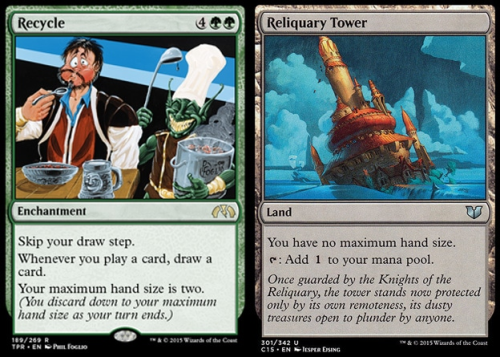
Commander Legends 2? Please, not yet.

A Magictation by Mikeal Basile

“Magictating” is defined as getting into the zone with your Magic the Gathering collection–thinking, planning, organizing, reminiscing about past games, and imagining future games. It is a combination of hard thinking about the game and calm meditation, reveling in the joy it brings you.
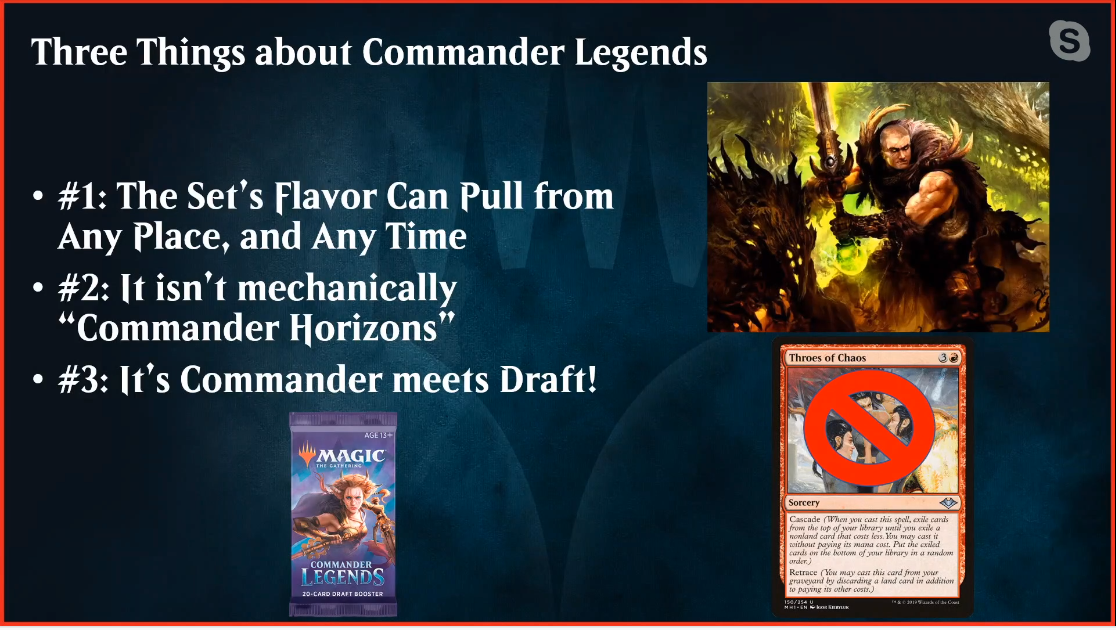
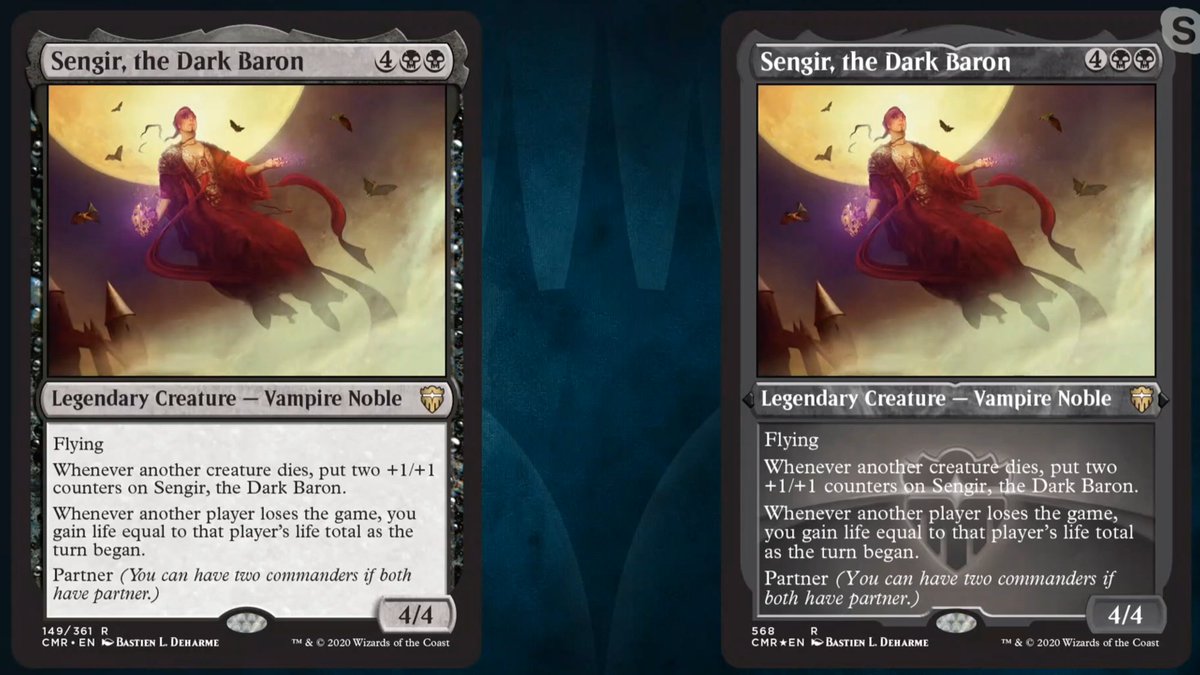
Mark Rosewater was recently posed the question, “If or When? Commander Legends 2, and his response was a question itself: “Would you all like that, yes or no?” By asking this question we have a great indication of how Wizards really is dedicated to listening to the players and trying to accommodate what we, as a community, want. That’s a wonderful and beautiful thing in this age of giant corporations using other companies to do market research on what their player base desires. While I’m sure focus groups and studies are still occurring these impromptu asks by Rosewater and others at Wizards (Verhey comes to mind) can really get the community very excited at times. As Commander players, we’ve been blessed enough to see that there is now dedicated focus on the most popular (strictly numbers wise) multiplayer format ever. So, the question Mark spins back on us is if we would like this. Well, I guess I’ll take a stab at answering that…

In short, no. I loved Commander Legends before it was even printed. So, there’s no need to read any further as we all know that the rest of this article is just an explanation about why this “no” is really just a “yes” in disguise. To be technical, no, we “all” will not want a Commander Legends 2. Despite Commander being the most popular format for multiplayer it isn’t played by the entire Magic community. Thusly, it cannot be wanted by “all” of us. Yet, I suspect that most of us that play Commander would welcome another Commander Legends. I think we can say yes, but only with a few caveats. So, here’s a list of demands concerning the possible or dare I say inevitable printed of Commander Legends 2:

  1. Give us time and give us space.
  2. Give us quality foils (I don’t even like them, but I don’t want useless untradeable cards either).
  3. Give us less power and more tribes.
  4. Make reprints a priority.
  5. Give us a draft/sealed environment.

Our number one demand needs to be time and space. It’s not you Wizards and Gavin Verhey, it’s us. We just need time and space to see our current Commanders in a more intimate setting. We need time to get to know our current pool of partners. We haven’t even had time to spend a few hours at our local gaming stores to get to know each other better. We need time to see others, and we need some space before we get introduced to a larger pool of possibilities. There are plenty of Pokemon (read Legendary Commander Creatures) in the sea, but we don’t need to catch them all. If we end up getting another Commander Legends set in the next year or even two, then I would say we could experience some serious burnout far faster than we may suspect. We need time to expand our collections. The legendary creatures “as fan” (number of times legendary creatures appear in packs) has been pretty solid for the last several sets. We have had no shortage of Commander centric leaders for several sets now. In addition, we are still getting yearly Commander decks with new cards, and plenty of cool staple reprints. It does beg the question, “Do we really need another dedicated Commander product?” Perhaps we don’t right now, but we are coming off the “year of Commander”, so I don’t think we will be for such a spoiled time in the near future. Hopefully, this call for feedback is in order to plan a long term goal. So, yes, we want a Commander Legends 2, but only if it takes awhile to come out.

Now, I don’t often harp about quality control issues. I hate piling on to obvious criticisms. It’s pretty clear that there are some serious issues with the average foil cards from Commander Legends. I bought a Collector’s Box (and lots of regular boxes) of Commander Legends and I was horribly disappointed whenever I opened a traditional mythic rare or extended art rare that was foil. I knew it would be difficult to trade, not worth as much as non-pringled foil cards, and it wouldn’t shuffle well in my decks. In contrast, I loved opening the foil etched cards. Those foils have not curled a wink, and they look unique enough that I actually run them. The foiling treatment is just much more fun than a traditional shiny laminate. This is saying a lot considering I’m the guy that has tried to trade away every foil rare or mythic I have ever opened. Seriously, I open foils and they go to the trade binder. Now, if we can get a Commander Legends 2 that capitalizes on foil etched cards, and eschews the issues from its other poorly foiled cards, then we have a recipe for some seriously collectible and fun cardboard! We need Commander Legends 2 to fix the problems from Commander Legends 1 and capitalize on its successes. That’s a simple statement, but not a simple thing to execute. So, yes to Commander Legends 2 as long as the quality control issues are fixed (of note…they appear to be as of Strixhaven J).

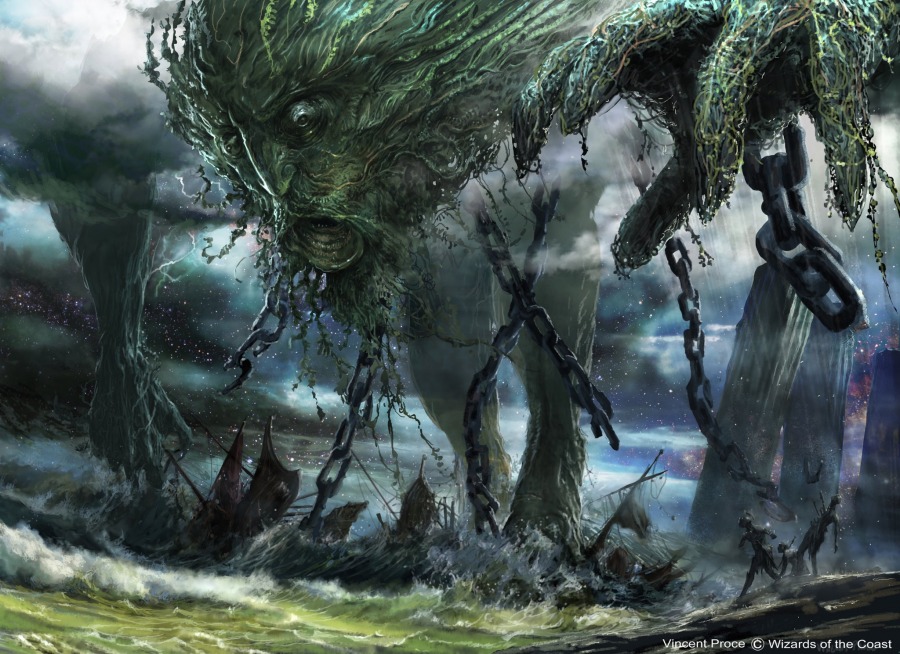
Another way to capitalize on prior success and continue innovating could happen by giving more tribal support cards to popular yet underserved tribes. I’m looking at tribes like Samurai, Treefolk, Kithkin, or Drakes, as a few examples of tribes that could use a little extra love from R&D. The power level for Commander Legends was spot on. The cards allowed draft to actually work and create a fairly balanced and swingy end game. Big spells actually had a big impact, and people were forced to build with a long game in mind. There was no way to rush the table and crush everyone in some sort of Zergling rush (StarCraft reference) where everyone is defeated before they can even get anything fully developed. Many people feared that a dedicated Commander set would be full of cards like Opposition Agent and Hullbreacher. It was not. Those are perhaps the two most maligned cards in the set. Jeweled Lotus hasn’t been the format warper that its original inspiration has always been. In casual pods it doesn’t even place as big of a target as a turn 1 Sol-Ring has. The boogey-men of Commander Legends was really just a couple of cards that were a bit pushed…as in two. Commander Legends 2 will need to emulate this style of design. The cards will need to be balanced, but not overpowered. The worst thing a Commander Legends 2 set could do would be to create some sort of Urza’s block power creep. The Combo Winter that crushed many people’s days of fun revolved around incredibly powerful cards like Tolarian Academy and Time Spiral. I remember losing on my oppoent’s turn 1 before I even got to play a card. That’s not what I expected to see in a Standard format. It’s definitely not what I want to see in a Commander game. Commander Legends was not like that at all. We have since seen that Commander Legends was creative, fun, and non-format warping all at the same time. So, yes, we need more of well-balanced design in Commander Legends 2.
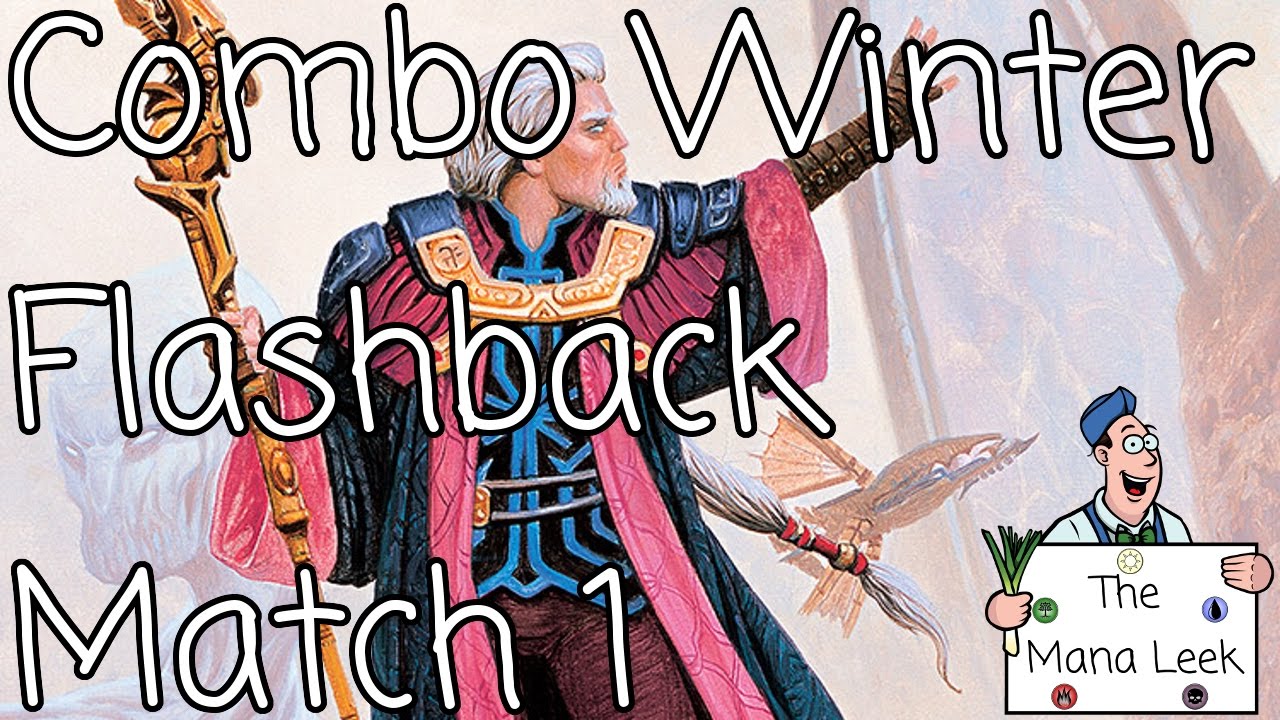
https://magic.wizards.com/en/articles/archive/magic-online/throwback-standard-gauntlet-2-combo-winter-urza-block-2017-05-04

One way to keep the format from being warped is to provide plenty of reprints. I’ve gushed over the beauty of the artwork and the utility that Strixhaven’s Mystical Archive provides, and I feel that Commander Legends could easily do something similar. A foil etched slot dedicated to format staples would be a really cool concept for Command Legends 2. Imagine that every pack comes with 2 Commanders (Legendary Creatures), 1 rare/mythic, and 1 foil etched reprint (or some other cool artsy alternative). How exciting would a pack of that be to open? How exciting would drafting a set like that be? People would have more access to great cards like Mana Drain, Swords to Plowshares, Demonic Tutor, Doubling Season, Sneak Attack, and Mana Crypt all without sacrificing the ability to play them in a limited environment. If any limited environment can absorb these powerful pieces it would be the multiplayer draft environment. This even solves the power-creep problem by using powerful reprints in place of pushed cards to drive up the value of boxes. So, yes please to a Commander Legends 2 that takes advantage of its unique ability to provide powerful reprints.

I’ve heard a few rumblings about not desiring the limited format for Commander Legends 2. I don’t get that. I’m assuming it’s mostly because people didn’t get a chance to draft it. I’m assuming they couldn’t even play sealed using remote technologies. I’ve played Commander Legends sealed, and it’s seriously a good bargain. The boxes have been cheap enough that drafting it feels similar to drafting Double Masters, but without the hefty price tag. Granted, the value may not be as high, but when you get to draft and keep cards, who is complaining? I think the draft format could benefit from borrowing even more mechanics and maybe even reprints from the other seriously fun mutilplayer draft sets—Conspiracy & Conspiracy Take the Crown. Conspiracy 1 & 2 were great fun. Those cards are also great fun in Commander. They have that political flair to them, and a politically oriented design which is a perfect fit for Commander. We need the next Commander Legends set to offer a good limited experience for both draft and sealed deck. It allows us to crack packs, play with “janky” cards, and rip apart the draft chaff decks and actually build with the same “janky” cards that allow us to beef up old and new synergies. This type of multipurpose set is a great deal for players. Including premium foil and premium artwork within the draft experience is another way to hit both the set boost pack crackers and the drafters all at once. Considering that it’s a Commander-based product the limited environment doesn’t need to offer superb competitive flair. It just needs to have the right feel and the right ebb and flow for Commander games. This is clearly something that Wizards has shown they are capable of doing, and we will definitely need it from Commander Legends 2. So, yes please to a well-balanced Commander Legends 2 sealed experience.

Whether or not we will see a Commander Legends 2 isn’t quite a question of if, but when. I would expect that the earliest we would see Commander Legends 2 will be in about 2 years. However, I wouldn’t be surprised to see it surface a few months before. It shouldn’t require as much play-testing or development as say a Standard set. Wizard’s doesn’t have to worry about drastically warping eternal formats, because they’ve said they aren’t worried about it. That alone helps cut the time down from development to print. I think the two year timeline is honestly the earliest we might be “ready” for such a set. However, with the growing call for nostalgia and reprints being constant threads in the Commander community we can bet that Wizards will be anxious to offer us exactly what we are asking for. I expect that we will see many of the current cards people are calling for now to reappear in a set like this. It will need to innovative in the same ways that Conspiracy Take the Crown innovated on the original Conspiracy mechanics. Partner Commanders and a plethora of legendary creatures will definitely need to exist. The question is what sort of mechanics we will see tribes and abilities being focused on. I’m hoping we see a whole myriad of possibilities! I wish you all the very best of deck construction and mulligans, and may the cards be ever in your favor!

Strixhaven the Set A Quick Run Down

A Magictation by Mikeal Basile

“Magictating” is defined as getting into the zone with your Magic the Gathering collection–thinking, planning, organizing, reminiscing about past games, and imagining future games. It is a combination of hard thinking about the game and calm meditation, reveling in the joy it brings you.

Strixhaven is here, and what cards should be on your Commander format shortlist for each color, school, and rarity? What’s going to be the most fun to play in the most social format ever? Let’s find out. There’s some clear standouts and a few “sleepers” here, so I’d like to dig into this piece by piece. We’ll go through the best commons, uncommons, and rares/mythics by color. I’m going to focus on the uncommons and commons over the rares and mythics. The rares and mythics are usually pretty clear as to what decks and strategies they speak to, but the others hold the key to how much playable value is lurking beneath the surface.

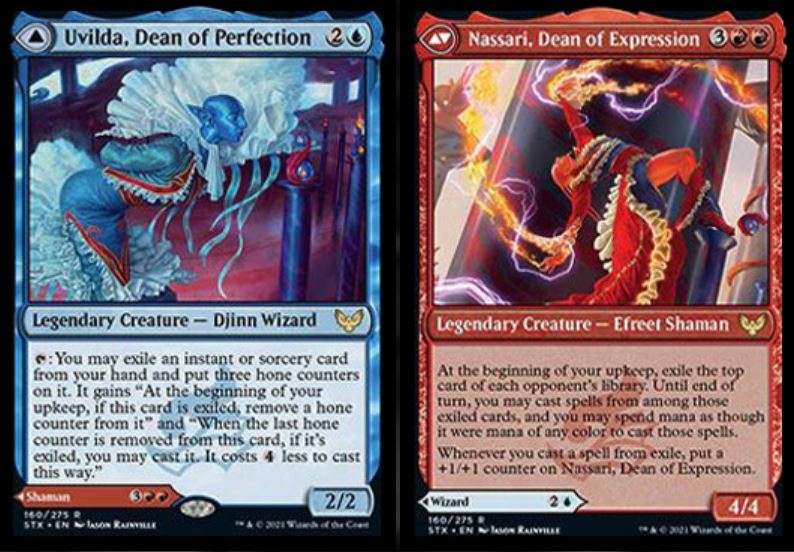
White has some interesting cards in this set. Several Magic designers have openly stated that they are trying out new things for White, and whatever they throw at the wall and sticks is what they’re going with. For the sake of excitement there’s Secret Rendezvous. This is not Alan Seeger’s excellent poem, “I have a Rendezvous with Death”, but a secret card draw spell for white. It’s similar to Homeland’s Truce. You and an opponent each get to draw cards. You are spending a card to cast this, so you are being “disadvantaged” when compared to the opponent you are sharing the gift with. Perhaps that’s a good way for white to get card draw. It helps others while helping itself? It seems mostly on point. There’s certainly precedence for it. Meanwhile, the other white mechanic being attempted here is the one on Mila, Crafty Companion. This isn’t a monowhite cards, so it doesn’t get to be slotted into mono-white decks. That’s the biggest downside to this card. If it was something that could be jammed in any mono-white build, then perhaps we’d find out a lot faster how flavorful and effective a taxable draw is in a white deck. I suspect that this mechanic will fit nicely in white. There’s some precedence for white taxing other colors with cards as early as Karma, and more recent cards like Ghostly Prison. Seeing white get the taxable draw mechanic seems like a decent way to go. I’m certainly not opposed to white being able to do this. The last addition to white card draw is Introduction to Prophecy. Scry 2 and then draw card. Wait, that’s a colorless card you say. Well, my friends, I don’t expect a single mono-white deck in existence not to suddenly jam this in the 99. I’m not kidding. While other colors have other options for drawing cards, this is now one of white’s best options. To be blunt, Introduction to Prophecy will be everyone’s mono-white introduction to the philosophy of cycling through their decks and selecting the best cards for each situation. It’s a pricey cantrip, but the scry makes it worth it in a color so starved for worthwhile cantrips and card selection.

I love the not so great original Sea Serpent. I also enjoy modern takes on sea serpents like this new Wormhole Serpent. Wow, this going to be fun in an Arixmethes the Slumbering Isle or other sea monster build. Making giant sea monsters so slippery they are unblockable is very fun for their controllers. It might be painful for those dealing with the unblockable serpents. The best part of this is that it will draw removal away from the more serious threats that you have on the board. Wormhole Serpent makes all those random big creatures without evasion into terrifying game-ending beat-sticks. I’m so looking forward to sliding this one into a deck.

Speaking of playing for fun, Snow-Day is wonderful. I’m a teacher by trade, and I look forward to snow days more than my students. I cannot wait to cast this during my next snow day and declare myself an auto-winner for flavorful play of the day. Of course I’ll probably feel someone’s wrath shortly afterward. Feel free to keep one handy on snowy nights. Snow Day is no Ingenious Mastery (which is so silly good and silly flexible), but it really feels like a fun card to run. Meanwhile, Curate looks to be a fun card as well for sifting decks and reanimating strategies. Meanwhile, Multiple Choice, much like its real world counterpart seems so flexible and useful at first glance. However, it really is just another disappointing and limited tool. I wasn’t overly excited about anything mono-blue in this set. The MDFC cards that have blue in them, and the traditional multi-color cards with blue are definitely exciting. It’s nice to see that mono-blue isn’t getting all the love, but then again it really hasn’t for many years now. It seems to get the randomly or inexplicable powerhouse every now and then. I can’t help but point to cards like Hullbreacher or even the once hated True-Name Nemesis (who doesn’t seem quite so broken these days). Blue has some decent stuff lurking below the surface.

I’ve had my eye on Eyetwitch, and I’m just so happy to see another creature that can attack when I have my Evil Eye of Orms by Gor in play. That combined with Evil Eye of Urborg, and we’re inching closer to Sauron’s Evil Eye Tribal. Perhaps when the Lord of the Rings set releases we will get a Legendary Eye to helm that absurd deck. Keep your eyes peeled for those spoilers. Ok, sorry, I have the puns out of my system now. Anyway, Eyetwitch looks like great fun in reanimator strategies. It provides a sacrifice outlet for cards like Victimize while using the Learn mechanic to dump reanimation targets into the graveyard. Another grossly good common is Plumb the Forbidden. That card looks seriously strong in any tokens deck or anything running Gravepact. I have a feeling people will be plumbing the depths of despair with this seriously solid common. Crushing Disappointment feels like it won’t be as good as we hope it to be. Making everyone lose life while drawing two cards is decent, but I just don’t love leaving up four mana to draw two cards. Blue black decks will struggle to find room for this, and I doubt it will actually slot in, unless you just don’t have other alternatives in your collection. The best place for Crushing Disappointment will be life-loss decks, like Rakdos, Lord of Riots decks, and a few others of its ilk. Of course, it being an instant doesn’t mesh all that well with casting creatures unless you have your pall the Vedalken Orrery out. Now, Tenured Inkcaster looks grossly powerful for Marchesa builds. Any black and X deck boasting +1/+1 counters is slotting this thing in and stealing games with it as well. It’s a bit like casting an Overrun that doesn’t require you to actually deal the combat damage. If you go wide with this in a black white tokens and counters deck, then this card is a dangerous and powerful finisher. It laughs at Spore Frog and that Constant Mists that keeps being bought back. This is the type of uncommon I love to see, because it functions like a mythic rare in the right decks. As for Mage Hunter, I’m impressed with its hateful mechanic. It feels like a modern  take on Ichneumon Druid. Granted this helps punish people doing more than just casting extra spells—you get to nail them for each copy they place on the stack. It feels like using Chain of Smog, Professor Onyx, Hive Mind, and Mage Hunter will be a Johnny Combo Player dream come true. Meanwhile, Unwilling ingredient might be the cutest and most flavorful one mana black creature since Blood Pet. I’m loving the design on that card. There’s a surprising depth of usefulness in black’s uncommons and commons. The problem is that the cards are really only good in particular archetypes and shine only when coupled with synergistic cards. I don’t really believe that’s actually a problem, but a pretty great thing. Don’t be afraid to plumb the depths of darkness in black’s Strixhaven offerings.

Red commons seemed less than exciting to me this time around. Sure, Heated Debate is neat in that it is uncounterable. Three mana for four damage at instant speed is an interesting version of Flames of the Bloodhand. I’ll probably skip running Heated Debate in just about every Commander deck I have. I struggled to find anything exciting in the red commons. The Blood Age General seemed neat in the right Boros builds, and that’s it. Oh, wait, I did notice a dragon card—Dragon’s Approach. That seems like a meme deck, and I fully expect several more versions of it to keep getting listed by people. This is a deck that demands some mathematics. I’m not super interested in building it, but I know I will. I have pages of red dragons just waiting to be cheated in with something other than Dragon Storm. I love that this card actually makes Spell Weaver Helix something that can be played in Commander. I had a sweet Crush of Wurms and Life from the Loam deck that I ran back when Ravnica first came out. I’m excited to build something with Spell Weaver Helix again. Imprinting Dragon’s Approach and Dragon Storm on that Spell Weaver Helix seems like a really fun thing to do in Commander. Spell Weaver Helix is a card that I’ve longingly looked at and wished I could find a way to abuse. Thankfully, the door is open, and dragons will be coming! Maybe I’ll try and do something gross with Balustrade Spy, Bladewing the Risen, and few other sneaky tools. This is another Johnny Combo Player beauty. It feels like this set was made for the combo player in us all. The red uncommons feel pretty narrow, and where the other colors seemed to have some real solid synergies that enabled a few of the cards to be worth serious consideration, I just don’t see it in red. Academic Dispute is maybe a cool and spicy combat tool? The rest just feel very clunky and not particularly exciting. Sorry red, but you’ve gotten plenty of love or should I say treasures, lately.

Green is usually gas. Green gets the most love in modern Magic, and I don’t think Strixhaven (the spells matter set) disappoints for the “creatures matter most” color. Before I speak about a couple neat creatures I’d like to say that the spicy life gain that green is seeing really harkens back to original green’s love for life gain. Stream of Life was the original big life gain spell, and it wasn’t until Alabaster Potion was printed that we got to see white take on a dedicated life gain role. Fortifying Draught (pronounced draft) is a sneaky and wonderful tool for life gain decks. I can totally see someone activating a wellwisher or sacrificing beasts to Ravenous Baloth to one shot someone out of nowhere with this. That’s the type of ridiculous play I love to see. Also, don’t forget that if your creature has lifelink and double strike you can cast this after the first strike damage is dealt, and then pump your creature for gross amounts of damage. Just a fun trick that was first pioneered by Umezawa’s Jitte users back in the days of Kamigawa block. Devouring Tendrils is no Tendrils of Agony. It’s OK, but it’s the type of conditional green creature dependent removal that can be OK, but can also just be utterly useless. To wrap up the spells I’d like to mention how nicely flexible Tangletrap is. Flier hate that hits most fliers that matter, and artifact hate for all those equipment that run wild on everyone. Blow up those swords or knock out those pesky angels with Tangletrap. Now for creatures the standout at common and uncommon is definitely Reckless Amplimancer. I mean elves definitely needed another two mana elf that scales grossly as the game goes longer, right? It’s a solid include in most elf builds, and a fine filler for early builders. Bookwurm is an intriguing card, but even though it replaces itself, I’m not sure I want to spend 8 mana on a 7/7 trample that draws me a card. It does have potential to be annoying, and so by replacing itself and gaining 3 life it could be a decent enough filler in decks that need card draw, big creatures, and perhaps cheap (monetarily inexpensive) reanimation targets. Overall, green leaves most of its grossly powerful cards for the set in the rare and mythic slots. However, overall, the cards are just more narrow.

Getting buffeted with “good-stuff” in every color set after set makes building decks a bit less exciting. However, when good cards show up for particular strategies, then we are allowed to brew and tinker and make our decks our own. So, I feel that despite seeing so many decent cards in the common and uncommons slots for reach color we actually have a decent quality set for Commander play. The rares and mythics are no exception to the design theory in this set. The set, as a whole, appears to be very mechanically driven. The cards in the set work very well when they are allowed to synergize with other cards. If you take most of the mythics and rares from this set and randomly slot them into decks of the appropriate colors you may find yourself disappointed when you draw them. When you look at the elder dragons you’ll see what I mean. They don’t just go in any deck running those colors. They either demand a deck built around them as the commander, or they require a deck that leverages the same mechanics and abilities that they possess or enable. This set is really a breath of fresh air for a standard set.

Most cards in the set are not good in a vacuum, and don’t slot into “good stuff” decks. That’s quite the accomplishment when you consider just how many cards a set like Throne of Eldraine allowed us to just toss into any deck of that card’s color. I could go on about each individual mythic and rare, but I’ll just wrap things up by saying that the cycles that were made in this set are a great example of what I’m talking about. I just touched on the elder dragons, but let’s look at the commands for each school.

Lorehold Command isn’t something that every Boros deck wants or needs to run. At five mana it’s a bit intensive, and it can work in go wide strategies, but not necessarily an equipment based build or even a more controlling build. The same thing holds true for the

Prismari Command. It really needs ways to take advantage of its abilities and finds itself at a competitive mana cost where there are mana three mana card draw and removal spells that make this thing seem just OK in builds that don’t leverage it to greater effect. Spell slinger decks or phoenix type strategies seem the best place for this particular command.

Quandrix Command feels like an odd-ball hoser card. It can punish people running enchantment and artifact spells and recursion. The other modes seem to be a little lackluster for three mana, but they do offer options, and options are a powerful part of Magic.

Silverquill Command is another mediocre offering for black and white builds. It does have some interesting options, but I’d like to point out that this spell is not an instant. It’s a sorcery, and at that speed it really feels a lot less appealing. I’m not saying it should have been an instant, because then it’s a much more powerful card. Yet, as is…well, it’s got options.

Witherbloom Command is the cheapest of the bunch at only 2 mana. It’s probably also the most limited of them all, and really seems like something most Commander decks will be totally fine not running. I mean it does have options, but a slew of poor choices adds up to a poor card. I’m not saying it won’t be good in other formats, but in Commander…well, I’m not enamored.

The best parts of this set are still great things for Commander—Mystic Archive and synergy focused mechanics. The Mystical Archive cards are wonderful. This is probably the best way we’ve ever gotten reprints. They appear in every booster pack, offer unique art, and help break up the monotony of cracking packs for a set. Old reprints and new cards in the same pack is the perfect way to cater to both new and established players. The Mystical Archive isn’t part of the main set, and it may sound like a slight to the set when I say it’s the best part. I don’t mean that the base set itself is awful for Commander players. It does have plenty to offer, but its offerings are more in line with what a Standard set should offer to Commander players. This set gives us mechanically focused cards that slot well into mechanically similar decks. There are cards that work great when they synergize, but fall mostly flat without support. This helps keep power creep from becoming power leap. Overall, Strixhaven is a set that is Standard legal, has great flavor, and offers Commander players interesting and unique tools. That’s great set design, and I hope that we see more sets like this in the future.

Three Card Buying Tips from a Magic Card Addict

A Magictation by Mikeal Basile

“Magictating” is defined as getting into the zone with your Magic the Gathering collection–thinking, planning, organizing, reminiscing about past games, and imagining future games. It is a combination of hard thinking about the game and calm meditation, reveling in the joy it brings you.

My major new year’s resolution/collector’s quest was to buy a card a day every single day during the year of 2021. With the first quarter of the new year over I figured it was time for a check-in. So far, so great! I’ve learned an awful lot about purchasing cards. As a player and collector with 25 years of experience, buying cards is nothing new to me. I am a bargain hunter at heart, so much so my wife calls me “penny” when I’m being extra cheap, so this has been a real test of my frugality. I have spent many hours over the years researching prices, waiting for buying opportunities, and trading cards to gain incremental value. I’m no card store owner, and I’m no MTG day trader, so I’m not claiming I have all the answers. If anything, this quest has humbled me many times already. I have learned quite a few new tricks and I’d like to share three big lessons with you from the three months I’ve been at this quest. I’d like to offer my new three major Magic card buying tips that anyone can benefit from. If you’re looking to get the most out of your card buying experience, then please keep reading to find out what makes the most sense in today’s modern market.

RESEARCH CURRENT PRICES

This is the first big rule that I’ve always clung to, and it has always paid off. You need to educate yourself about what the current prices for certain cards are. Thankfully, this is really pretty easy with all the apps, websites, and internet access we now have. Back in the 90’s you had to reference Scry Magazine or  Duelist or other printed guides, and those could easily become out of date after a major tournament or development had taken place. It was pretty cool if you had the inside scoop, because I remember picking up some cards for ridiculously good prices when the seller wasn’t up to snuff on the current prices. I managed to pick up a Force of Will once for a Force of Nature trade-in offer. The Force of Nature was popular with the local players, and Force of Will was too much life and too many cards to justify playing. In today’s market it is much more difficult to find deals like these, but they do pop up now and again. I was at a Flea Market a few years ago, and I managed to pick up Alurens, Food Chains, and even a foil Arcbound Ravager for fifty cents each. They were in the unsorted bulk bins, and I pulled them out and stall owner didn’t even bat an eye as I forked over a few hundred in cash for the hundreds of cards I had pulled out. In today’s fast-paced market, I often find myself visiting MTGstocks to see if there’s a current pricing trend for a card or even to see if I’m buying a card at its current peak price. This research assures that you don’t end up over-paying for the cards you want. Also, it helps you realize when someone is offering a deal that needs to be snapped up.

I have over-payed a couple of times, but not by more than a dollar or two, and not more than three times so far this year. The times I ended up over-paying this year were a direct result of me not doing my prior research and hurrying up to buy my card for the day. So, when you are ready to buy a couple cards or maybe even 99 cards, I highly suggest you research the current prices first.

SHARE YOUR STORY

I have found that dealing with people is different from dealing with computers and video games. Games and computers have hard and fast rules, only respond to logical inputs, and often leave me feeling unfulfilled and annoyed. Meanwhile, talking with a fellow player or store owner is usually much more rewarding. Sharing your story about why you’re hunting cards down is often fun for others to hear. I love hearing about what plans people have for particular cards they are buying. These types of human interactions have been woefully absent from far too many of our lives for far too long. It is sad that we haven’t been able to gather for Magic, but half a million deaths is far sadder. I don’t want to be doom and gloom about what’s happened, but it has. Covid has temporarily crushed the gathering aspect, but I stress temporary. It’s sad, and I’m hopeful that our future will be far brighter. We will see a safe return to in-person playing, and we can enjoy our hobby with our fellow humans soon enough. This is a wonderful thought, and sharing our stories about what we bought during our time away from one another will be a way to share some joy with each other.

However, if you have the chance to chat with the dealer you’re working with, then they just might cut you a deal. The ability to haggle is something that not everyone has. I’m not really much of a haggler myself. My father-in-law loves to give salesmen a hard time, whereas I like to give them a good time. I guess I just figure that if we all enjoy one another’s time, then perhaps the seller will offer me their best price. People can buy cards anywhere, but you can’t talk turkey just anywhere. Going to your LGS, chatting about cards, sets, and ideas is great for everyone involved. This often leads to all of us building human capital. We appreciate each other more, and as a result we respect one another a bit more. In mutual respect comes mutual acknowledgement of each other’s needs. We know our store needs to make money, and our store knows we only have so much to spend. When these two things meet in the middle it is a beautiful thing. I’ve even found this helpful when placing orders through online dealers by making contact with my store through email.

Humans have always told stories, and it is our stories that connect us. I know we don’t all have the gift of gab, but perhaps gifting a little gab about our passion will get us all farther in the end. Wisdom through experience and knowledge through absorption. Talking about what joys we anticipate and what cards bring us fond memories is a great way to begin our face to face transactions. When making offers online it can be easy to eschew our human nature for expedient communication. That is not the way to gain human capital or further your network of friendly Magic players. Tell your story a bit, and you may end up with another good deal to share.

IF IT’S TOO GOOD TO BE TRUE…

I’ll be honest that there are days I can’t get to my LGS to make my purchase. There are days that I don’t find what I need on my LGS’s website, and so I’ve turned to eBay and TCG player to find the cards I want. Now, I remember using eBay when it was normal to buy from non-power sellers. I often bought from other people, because that’s who was selling cards. It would take up to a month to get cards, but they almost always came. I only ever had to file 2 complaints during the first decade I used Ebay. When I began this quest I had made several predictions. One of which was that I would have no mailing or delivery issues. I had high faith in the systems. I was proven wrong. I saw a seller with no reviews, but several cards posted for sale. The cards were all very cheap, and the pictures were all original. They were taken with a cell phone, were blurry, and all had the same hand holding each card that was for sale. This told me this was probably just a regular person trying to sell extra cards for a little extra cash. The cheap prices probably just meant they wanted the money now. So, I took the bait and bought four cards. I waited, and waited, and waited. I kept wondering if it was too good to be true. Could I be getting ripped off? Man, I really wanted to play with those cards. I had to play games without the cards I had planned on having. I had decks ready to go and couldn’t run them because the commander wasn’t here yet. Finally, I contacted the seller and then shortly afterwards filed a claim. It stunk. I felt bad about it, but realized that I shouldn’t be the one who feels bad. I’m not the one scamming someone. I got my money back, eventually, and then set off to re-purchase the cards I had originally bought. Thankfully, I was able to replace all of the cards for even less than I had payed for them initially.

The lesson here is that if it seems too good to be true, then it probably isn’t. A simple lesson, and I had to learn it the hard way. I will say that I’ve never had this problem when I go to my LGS, pick out a card, pay for it, and then sleeve up within a few minutes of arriving home. Heck, my PayPal payment doesn’t even clear before I sleeve up a card from my LGS. The consistency, safety, and convenience of buying in-person should never be under estimated. Once you factor shipping and the hidden time cost of buying online, it can be easy to see the advantages of picking up your cards locally.

In this digital age people often believe that nothing tops the convenience of online ordering. I can actually imagine a world where people pay for MTG PRIME and have cards shipped in one day to their homes. It sounds awful to me. It destroys the very things that keep our gaming traditions and our gaming cultures alive and developing. We don’t evolve when we isolate. Like any species that is isolated we turn to specialization in order to thrive. Yet, when our specialization turns us away from the foundational elements of success, how are we to ever continue to evolve. I would think that de-evolution is the only course that could arise from this state. We could very well become morlocks from H.G. Well’s The Time Machine, only playing Magic on Arena and never gathering again. A simple series of button emoticons will express our only thoughts while playing…yuck! We could allow our gathering skills to atrophy and ultimately disappear. The game would evolve, but the course of its evolution could lead to an elimination of what brings so many of us to Magic. Gathering is key, and when we support our local stores, then we support our own ability to gather.

I have more often played with my friends at a kitchen table or other home furnishing than at my LGS. That doesn’t mean I don’t love going to the store and spending time there. I do. It’s awesome. I just find that the play group I’ve developed over years has been a result of people I’ve met through Magic, and so I know that without those stores that story and that cycle of players and friends developing life-long connections from Magic will cease to exist. As someone that has found amazing friends through Magic, I can say that Magic: the Gathering has made my life better, and that any way to help support this subculture (supporting a local store whenever possible) is more than worth doing. In a world where we vote with our money, I choose to vote locally, and I choose to keep this game alive and running.

Keeping your research current, sharing your stories, and avoiding crazy good deals are the top three tips I have to offer at this time. I’ve learned plenty of other lessons from buying a card every single day, but for now I’ll leave you with these three. These three tips can help anyone out there get the best bang for their buck. I have more tips and tricks to share, but for now I think these three should be enough to keep your collections growing without pillaging your wallets. Until next time, I hope Magic brings you as much joy as it keeps brining to me. 

Mystical Archives’ Artistic Advancements

A Magictation by Mikeal Basile

“Magictating” is defined as getting into the zone with your Magic the Gathering collection–thinking, planning, organizing, reminiscing about past games, and imagining future games. It is a combination of hard thinking about the game and calm meditation, reveling in the joy it brings you.

The Mystical Archive cards are really pretty cool. They’re not like Secret Lair cards, and that’s a good thing. These bonus cards are exactly the type of bonus that Magic needs to include in their regular packs as often as possible. These cards are no where near as rare as the inventions from Kaladesh or those pretty cool Expeditions we’ve seen twice over now. They are even more plentiful than the most recent “bonus slot” that we saw with the time shifted cards in Time Spiral Remastered. The frequency at which Mystical Archive cards appear is honestly a boon to most players. I don’t foresee these becoming super collectible, as the supply should be super high on these things. Cassie, on Cassie’s Calls for TCG player, had a great take on these cards, and I agree with her as for their future projected values. I’m more excited to discuss the aesthetic effect these cards create.

Let’s go back a few months to when Commander Legends came out. Opening packs of Commander Legends was just awesome. As a Commander/EDH player I just love seeing legendary creatures in my packs. I love seeing big flashy spells. When flashy spells, multiple legendary creatures, and bonus rares show up in my packs, well, I’m over the moon about it. I just feel like I’m getting more for my money. The playable value of commons and uncommons for my Commander/EDH collection just continues to grow. Avoiding chaff and bolstering my ability to build multiple decks from pack cracking is where I want to be whenever I peeling foil wrappers off packs. I love buying singles, but the rush of cracking a pack—well, you know. Everyone loves that fresh ink smell.  I wrote about the playable value that Commander Legends had, and that is similar to what we find in Strixhaven. There’s some solid value at the rare and uncommon range for Commander players, and there’s a few commons that come to mind as being potential staples for deck building. So, cracking some packs and walking away with usable cards is pretty likely. The commons and uncommons don’t overwhelmingly seem to be great fits for varieties of Commander/EDH archetypes. This is no Commander Legends 2 (it is a Standard set after all), but it is still a pretty solid set for the Commander community. We can look forward to getting a decent number of legendary creatures and several worthwhile spells for all levels of competitiveness.

Even more than the playable value or legendary as-fan (how often a legendary card appears in a pack), the variety of art is what I’m most excited by in these Strixhaven packs. Too often I find myself a bit bored with the homogenized art style in Magic’s recent sets. Now, I’m not at all trying to say that the artwork isn’t excellent. It is. The art is great, the artists are fantastically talented, and aside from the random cards by a few of the older artists with unique styles (Rebecca Guay comes to mind, obviously) the art is very similar. I guess my gripe might be aimed more adequately at Magic’s art director? I’m honestly unsure. Yet, I am a lot less “gripe-y” about having these unique looking cards in every pack. They really serve to break up the art style. I mean, sure, Seb McKinnon and a few others have styles that differ a bit, but it really isn’t like it was back in the 90’s. I’m not saying that the 90’s was perfect, or anything near perfect to be totally honest. Yet, the art had a variety about it. When you opened packs of card the artwork wasn’t super similar. The Mystical Archive provides artistic variety similarly to those great comic book showcase treatments that Ikoria did. Ikoria did a lot of things right for a set released when a lot of things were going wrong the whole world over. It provided people with many of their favorite non-Magic IP property treatments (the Godzilla-skinned cards) and it utilized showcase treatments to provide a unique art style within the context of its overall world. The Mystical Archive fills this gap in a unique way.

Over the years, it seems like there’s a push to ensure that we feel the cards and characters are all from the same world. Yet, does that mean they all need to be styled alike? I wouldn’t think so, but if you look at Magic’s art direction it clearly seems to point in exactly that direction. Making all your creatures of a certain type look similar in a given world helps lend it consistency. The horned elves of Lorwyn or the Merfolk of Ixalan seem to be solid examples of that style of art direction. The crystalline themes throughout the Ikoria set also brought this home. Yet, I’m not convinced the entire art style needs to be adopted in order to sell us that story. Those Ikoria cards with the showcase treatments still incorporated crystals and feel of the plane, but managed to provide a variety of artistic treatments that were stylistically unique. It seems that in selling us a story we’ve lost that fine art feel that Magic could once give you. You could open packs where artworks were wildly different, and you could debate with your friends about which artist had the best style. I’m not sure this debate can even exist as it once did. Today’s art is all so hyper realistic—which is fine when it’s a few artists styles, but becomes a bit repetitive when it’s all we see. I don’t want to sound like I’m being negative. I love Magic, and I love Magic card art. I enjoy the modern hyper realistic art style, but I also miss cards that were after Quintin Hoover’s comic book style. I miss the artistic variety that could once be found in a normal pack of cards. Strixhaven’s Mystical Archive cards bring that back. They do it in a way that’s very similar to Ikoria’s showcase treatments. However, they do it all while combining people’s requests for reprints. It’s the beauty of “the list” reprints and showcase treatments combined.

I guess that’s another reason I loved these Mystical Archive cards. You could get totally different vibes from a variety of creatures or spells, and still believe that it was all the same “world” or “plane” without issue. By using this lithographic or manuscript style and making the cards have their own feel and way of existing in the world of Strixhaven is really a stroke of genius (why wasn’t that in the mystical archive…hmmm). I mean, they must’ve untapped their Tolarian Academy and had a real turnabout in order to come to the conclusion that providing reprints, utilizing showcase treatments, and still tying it all back to the current set’s plane is just phenomenal. Really, when I step back and think about how that all works together I’m so pleasantly pleased by it all that I’m shocked it didn’t happen earlier. Whoever had this brainchild deserves some serious KUDOS! When you look at the evolution of cards and treatments from Ikoria through now the evolutionary line seems pretty clear. I’m even accounting for the “out of planned order” release of sets. This progressive build to making reprints highly available in each pack while still linking them with the plane and yet creating visually unique versions is awesome. In short, Mystical Archive cards get everything right. I know that not everyone will like the border treatments or even the art style. That’s not the point. The point is that we can have cards that buck the current trends, create unique takes, and still work within the greater framework of the game. This is wonderfully positive news. These spells of the past bring unprecedented hope for the future of Magic: the Gathering.

It is going to be very cool when we get a chance to reflect back on this set and see what it helped lead to in the next ten years or so. These series of advancements in art variety, reprint accessibility, and story inclusion are promising indeed. Being able to discuss and talk about this is really cool. I hope that we are in an even better space a year from now, and that we will be free to discuss this at our tables–together–while shuffling and debating who has the best Brainstorm art in their 99.

How Bans save Commander Players Money

A Magictation by Mikeal Basile

“Magictating” is defined as getting into the zone with your Magic the Gathering collection–thinking, planning, organizing, reminiscing about past games, and imagining future games. It is a combination of hard thinking about the game and calm meditation, reveling in the joy it brings you.

**This article was originally published on February 17th shortly after the bans were announced. This is just the reposted and unrevised version (I did not “fix” any predictions I made).** You can read the original article here.

If you don’t care about bans in other formats because you’re a Commander or kitchen table player, then you are missing out. No, I’m not saying you should start playing Standard or Modern or some other format that has bans and cares about diverse competitive meta-game environments. I actually enjoy not having to fret about all those particulars. However, when it literally pays to have your ear to the ground about bannings, well now I suspect you’re willing to listen. What do these formats have to do with Commander? Nothing. Nothing at all, except that they can help drive the prices for cards up or down. Sure, Commander drives the prices on some cards. When a card like Uro, Titan of Nature’s Wrath gets banned, well, it’s time to start thinking about picking one up. The beauty of this is that cards that were perhaps out of your budget will usually tank enough to make it into your dream deck. It’s hard to say exactly when this time is, but I have a few guidelines that might help you decide when to pick up some banned list beauties.

Looking at the card prices of other banned and restricted announcements is the place to start. If we look back to the Companion nerf ban, then we can get a decent idea about what cards tend to do when they’re part of a Standard set and get banned in other formats. I’d like to look at Lurrus of the Dream-Den first. This card was preselling for anywhere from $14-20 each. Then it dipped shortly after release to around $6 or so. Then everyone found out how incredibly powerful Lurrus was in nearly every format. It went up over $25 each! Then the rules change struck; Lurrus and the rest of its companions were left having to pay rent. In two weeks Lurrus dropped back down to under $5. This implies that we can get a good deal on cards that were powerful, but are no longer playable by the popular formats that were previously driving demand for them. Standard is a powerful driver of demand in the Magic the Gathering market. If a deck is popular in Standard, then the rares and mythics in it will usually be up around $20-40 each. However, when those cards are also popular in Modern, Historic, and Pioneer…well, you get the idea. Demand goes up and supply can’t keep pace. So, if you’ve been like me, wishing you had a big greedy titan on your team, then the time to pick up Uro is coming.

What cards might you get for the best deal? Uro, obviously comes to mind, but others were banned as well. Have you seen that Omnath, Locus of Creation is no longer a thing in Historic? Well, that means the price on that thing is going to dip a bit too. Historic doesn’t seem to drive prices too much for now, but every little bit helps. I suspect that Omnath will hit a new all time low in price within the next two weeks. So, that’s exciting.

Speaking of dips, Field of the Dead has been struck down in Modern along with Tibalt’s Trickery, Simian Spirit Guide, Mystic Sanctuary, and of course my soon to be BFF Uro, Titan of Nature’s Wrath. This really just means that if you haven’t cracked a Tibalt’s Trickery yet, then you can probably pick up that super fun spell for way cheaper than you might have a few weeks from now. The Field of the Dead getting whacked is the card I’m more excited about. Field of the Dead is a solid value in Commander and tends to be super strong in decks that sacrifice or ramp or do both. The Simian Spirit Guide and Mystic Sanctuary are relatively cheap as is, so I’m not overly excited about their relative price points. Yet, as I’ve said, I suspect that Uro will be dropping shortly. I suspect that Uro’s drop in price will actually only be a temporary thing. Uro will become a much sought after Commander card for pretty much the next decade. Blue-green is all about ramp, card draw, and big creatures. Uro checks all those boxes. That’s just silly, and I honestly wonder why it’s taken so long for that thing to get banned in other formats.

Now, Legacy banned a different blue-green card that I’m just as excited to see take a slight dip in price as well. I’m speaking of course of Oko, Thief of Crowns. Legacy gave the boot to Dreadhorde Arcanist, Arcum’s Astrolabe, and Oko. I’m hoping this drives Oko’s price down to his most affordable yet. Oko was preselling for $20-30, ballooned up to nearly $55 for awhile, and eventually dropped down to $13-15 around May or so of last year. He’s been steadily on the rise again, but I think this will be another dip for him and I wouldn’t be surprised to see his price drop below $15 again. I feel that this will be one of the best times to pick that card up. It’s powerful like Dak Fadden was when he was first printed.  Planeswalkers are trickier for Wizards to reprint, so he’ll probably creep up in value over time. I’m looking forward to turning my friend’s indestructible creatures into lame 3/3’s sooner rather than later. This wouldn’t be the Uro article without mentioning him in this paragraph as well. He escaped the ban in Legacy, so that means that Uro is legal in the big three: Vintage, Legacy, and Commander. Those three areas will likely determine the demand for Uro, and I suspect most of that will come from the Commander community. I don’t follow Vintage and Legacy like I used to, but unless something major shifts, then I suspect Uro just doesn’t have the legs to drive much demand in those formats. Oko, Thief of Crowns will be the sweetest Legacy ban to snap up in the next two weeks or so. The Astrolabe is already cheap enough, so it’s not overly exciting. Dreadhorde Arcanist is also plenty cheap as is, but maybe it becomes an oddball bulk rare; who doesn’t love casting a Wheel of Fate for free! Overall, the changes to Legacy mean we can probably snag one of the strongest planeswalkers ever printed for a solid price.

Lurrus the Dream-Den was my example of choice as a card to follow not only because it fits the average price curve that occurs post ban, but because it has also seen an interesting change with the recent rules announcement. The unbanning of Lurrus the Dream-Den in Vintage means that premium versions of that card will start commanding a premium price. Vintage players actually own the Power Nine. Most Vintage players own at least one or two pieces of power or at least a few cards that are worth 2-3 times the most expensive Standard deck you can muster. What’s my point? The point is that these players want premium versions of these new “cheaper” cards. They tend not to enjoy shuffling a $5 rare if they can shuffle a $20-30 version of it instead. If you’re a Commander player that tends to foil out your deck with alternative versions and only the rarest basic lands, then you know the idea. This bit of flexing is common-place, and those of you that still have a few of those fancy versions hanging around can soon unload those cards for an opportunity to get even more cards. If you’ve got an extra extended art or foil Lurrus hanging around, then soon will be the time to trade it into your local store or your friend to pick up a few of those cards you’ve had on your collector’s list.

I like to read about the other formats and hear about the decks that are popular, but only because they help me stay informed about prices and synergies. I don’t catch everything, but I know how to get caught up on what I’ve missed. This new switch to banning cards whenever needed is a great thing for Commander players. We get to watch cards go on sale much more often, and that’s a nice thing. So, next time there’s a banning, I’ll be here to help you through it, but in the meantime, don’t be shy about reading about those other formats. Keeping your ears to the ground can pay off. When you hear about broken new decks and crazy new combos, then you should start thinking about just how you can benefit from when they get hammered into oblivion. Or as I like to think, exiled to the dream halls of Commander.  

Building with the Brainstorm Box

A Magictation by Mikeal Basile

“Magictating” is defined as getting into the zone with your Magic the Gathering collection–thinking, planning, organizing, reminiscing about past games, and imagining future games. It is a combination of hard thinking about the game and calm meditation, reveling in the joy it brings you.

I like to keep my cards organized. I wasn’t always good at it, and everything I’ve learned about organizing I’ve learned the hard way. Having a system to organize your Magic card collection is important. Organizing Magic cards is a tricky business for players. I have written on this topic before, and if you’re ready to take the deep dive into deck building, then I highly suggest you go read my other article about sorting for brewing. Today I’m going to provide you with an alternative way to build your Commander decks. Building a deck all at once can be instantly satisfying, but you might not always have a few hours strung together to do it. Perhaps you have several ideas for building Commander decks, and you just can’t finish them all. Whatever the reason, I have the deck building solution for you—the brainstorm box. I started doing this back in January. I needed a way to build multiple decks at once, but also be able to come back to them whenever I had time to spare. The brainstorm box allows you to build several decks at once without having to finish any in a single session.

The reasoning behind doing this particular style of deck construction is really two-fold. One benefit of the brainstorm box is keeping track of your ideas in a tangible and obvious location. It helps keep ideas from getting lost in the shuffle. I try to write my deck ideas down in my brainstorming notebook, but I don’t always remember to look them back up in time to build them. I sometimes stumble across them while I’m searching for a blank page, and then I’m down the Brownie-Tribal meets Kithkin alliance rabbit hole again. Basically, you need a place to physically keep your deck ideas while you are building them. The box helps make sure your decks have a shot of actually being finished. Forgotten deck lists do exist, and they are often buried beneath piles of paperwork. As nice as it is to unearth your Draganimation (Dragon Reanimation) decklist from 2003, it’s just a bummer to realize you never actually built it in the first place. The brainstorm box fixes this issue. You begin building even when you haven’t finished planning. It functions like a brainstorm session; you put your cards (read ideas) in a deck as you go. Your decks don’t have to be finished and you don’t have to abandon your paper plans. Use them together, but also allow yourself to begin building prior to finishing your planning. The deck begins to come together in an organic and natural fashion. 

The other main function that the brainstorm box fixes for building Commander decks is the time crunch. Responsibilities intrude on our Magic time more often than not. Unfortunately, some of us may end up abandoning deck building altogether, as we never have more than an hour or two free. Whenever we have more free time, then we’d prefer to actually be playing Magic, rather than building the deck to play the game. I get it. Not everyone has the time to build a deck from start to finish, and so we plan and plan and then forget. We pine for more time, and we may or may not get it. Having your deck physically waiting for you to finish it is highly motivating. Having a few cards and maybe all the lands it needs set aside in your brainstorm box really helps to visualize your goals. The idea behind this is simple, if you start building it, the deck will come. It’s a veritable field of dreamhalls waiting to happen. Being able to drop a few minutes here and there always helps to build your deck ever closer to its first form. I’ve built over eight decks so far this year using this very method. I currently have about twelve more in various stages of completion. I’m inching, in some cases quite literally, closer to completing my new decks each day. When you have small amounts of time that you can utilize well, then you are able to maximize your results. We all want to maximize our free time.

The reason for needing a brainstorm box is really something that can be blamed on Commander Legends. That set is amazing, but it also has given us so many new tools, new Commanders, and new tricks to play, that an explosion of deck building is still occurring over one set. That set has really helped explode the variety of Commanders that people have easy access to. Sure, you could play Ur-Drago or Tolsimir Wolf Blood, or even Gosta Dirk, but you probably prefer to play the newer “designed for Commander” legends instead. So, it’s no wonder that we all have so many more decks we want to build. Having such an explosion of unique and mechanically inspiring legends is wonderful. Thus, I started using the brainstorm box.

The brainstorm box is a physical plan for drafting your Commander decks. The plan for organizing Commander decks is simple. You start with a card or two that will represent your idea. If you are inspired by your Commander, then sleeve it up and toss it in the box. You can use a bundle case, a fat pack box, or any other card box that is large enough to house several Magic decks at once. Once you have a box dedicated toward Commander deck brainstorming, then you go ahead and start breaking it up into sections. I suggest using either dividers, sleeved cards, or paper slips with notes scrawled on them. I honestly prefer using my scraps of paper, because they are easily read, and feel a bit primitive. I like to consider myself an educated brute. So, when I open the lid of my brainstorm box I am greeted with scrawled names that denote which sections are dedicated to my budding dreams of Commander glory.

Once you have labels and dividers set, now you can start tossing together the cards for each deck idea. You can have as many or as few cards as you want to start the deck building process. I have deck ideas with as few as five measly cards and others that need only five cards to finish them. The way the box helps you move toward completion is highly satisfying. Seeing your decks get built feels good. A little tip for seeing added progress is to fill in the basic lands your deck needs so that it starts looking like a stack of cards early on. Seeing a wider stack makes you more inclined to keep it going and finish it up as soon as possible. Nothing quite like tricking you into doing work, which is fun, to avoid thinking of fun as work. Yeah…that was a bit much, sorry. Whenever I get cards in from a mail order, or a pick up from my LGS, then I come home and drop them into their appointed slots. I don’t even need minutes to do this sort of organizing. This takes moments. I may not have the time to even sleeve the cards into a rare binder, but I do have the time to drop them into the appropriate brainstorming slot in my Commander deck-building box.

Using the brainstorming box is fun. I highly suggest you try it out and maybe do so by snagging those uncommon legends you have from Commander Legends and start brewing those decks today. All it takes is a few scraps of paper and a spare box. This is a great way to maximize your time and efforts when you are deck building with limited free time. I know that several weeks or even a month can pass by, and I’m unable to carve out a multi-hour session for deck brewing. However, the brainstorming box allows me to chip in a few minutes whenever I have them. I am able to build multiple decks simultaneously. I can even clean up an entire brewing session early if I have to run off somewhere. I simply scoop up the deck, toss it in the box with its brutish label attached, and I can pick it up later right where I left off. A few additional pointers I’d like to suggest include keeping sleeves or basic lands in half the box to help fill it out when you are just starting off. As your number of decks increase in number and size then you may not need the filler space, and you can adjust accordingly. Also, as you finish builds it’s nice to have a checklist taped to the underside of the box to help you keep track of all your deck building accomplishments. I hope you find this useful and I know that the brainstorming box keeps me motivated and excited about deck building even when I’m crunched for time. Keep on magictating my friends, and I’ll see you at the Commander table again soon enough. 

If you haven’t already, then please consider subscribing to the blog. I really appreciate it when you take the time to read my articles, and I also really appreciate any feedback you have for me. Subscribing to the blog is one of the nicest ways to let me know that you want me to keep cranking out articles for all of you. I love doing this, so I hope you get as much joy from reading them as I do from writing them. May the cards be ever in your favor!
Should you play infinite combos in your Commander decks?

A Magictation by Mikeal Basile

“Magictating” is defined as getting into the zone with your Magic the Gathering collection–thinking, planning, organizing, reminiscing about past games, and imagining future games. It is a combination of hard thinking about the game and calm meditation, reveling in the joy it brings you.

If you are a die-hard combo player, then I think you’ve already found your answer. However, I’m more interested in parsing out if it’s acceptable to have an infinite combo in your Commander (EDH) deck. I’m not talking about cEDH mind you, because I’m pretty sure if it’s not banned, then it’s all good over in that sub-format. I don’t play Commander for cut-throat competition, but instead for friendly competition. I’m more of a social player, as are most Commander players, and as I’ve been over that avenue before I’d like to spend some time instead teasing out the issues inherent when employing combos in traditional Commander circles. For the sake of clarity, when I refer to infinite combos in this column I’m referencing game-ending combinations of cards that end the game. The complex question about their validity in casual Commander is comprised of many layers. Should we, as casual players, allow ourselves to employ the infinite combo? Is it right to have a deck that should otherwise have lost a game, suddenly win because we’ve assembled a two or three card combo? Do we need decks to have access to combos in order to avoid stalled board states? Is it against the spirit of the format to include combos that crush your friends while denying them the opportunity to fulfill their dreams? These are valid questions, and the answers are trickier to assemble than you might think.

Should we allow our friends to play infinite combos in their Commander decks? The answer here is found by rounding up some more questions. Is your idea of a good game one where players expand and develop strategies over time? If yes, then combos may still be acceptable. Do you want the game to progress and reset and progress again? If yes, then combos may still be acceptable. Do you want the game to end suddenly, and at times without warning? If yes, then mobilize those combos. Do you want people to win in ways that are clear and allow traditional answers to stop them from winning? If you answered yes to this, then you probably don’t want to see infinite combos in your games. Infinite combos win games, and they do so instantly: the game is over once the combo is initiated. I don’t necessarily have an issue with someone creating unlimited mana with their Basalt Monolith and their Power Artifact. This can happen fairly early, but unless the deck is solely built around capitalizing on this, then the table should have an opportunity to stop it. Traditional answers can be utilized and the game can be saved from the calamity of the combo. The key here is the vulnerability of the combo, and the viability of it to win the game on the spot. The ability to create an advantage that is difficult to overwhelm is far different from ending the game. I see no reason to scoop my cards up until I’m dead, and when other players run up an advantage that’s the opportunity for the rest of the multiplayer and political avenues of the Commander format to shine.

It may seem to some that combos are better when they end games, but it really depends on when and how that is happening. The difference here is subtle, but I don’t like losing to someone when they win using the same two or three cards every single game. This is one of the many reasons I don’t usually like having tutors in my decks. Sure, tutors can be used as a tool box concept, but I really don’t like seeing a deck that has fifteen tutor effects, a two card combo, fifteen pieces of recursion for the combo, and proceeds to follow the same lines of play every single game. I feel that is just not in the spirit of Commander. In fact, I would go so far as to say that game-ending combos destroy the soul of the casual Commander format. The format is casual, political, multiplayer. The infinite combo is inherently anti-casual. It is competitive to a degree that can lock out many decks from ever winning. It brings back memories of old tournament formats that ran along the lines of rock, paper, scissors (aggro, combo, control). The casual scene is not the place for hyper competitive combos. Additionally, combos ignore that there are multiple players (or in the worst cases ignores all other players). The worst offenders are decks that are essentially playing against themselves in an effort to assemble the pieces as quickly as possible. I don’t mind combo decks in other formats, but I’m fairly certain that those decks are breaking the social atmosphere of Commander. They crush people’s dreams and syphon away the fun that comes from the ebb and flow of a traditional multiplayer game. The last piece of the puzzle is the political aspect. The infinite game-ending combo eschews all political pretexts. When the combo player goes off it doesn’t matter what you wanted to do the next turn. It doesn’t matter how you could have helped one another to a first and second place victory. It doesn’t matter what your name is, because the combo just stole the game. In essence, the infinite game-ending combination crushes the soul of a Commander game.

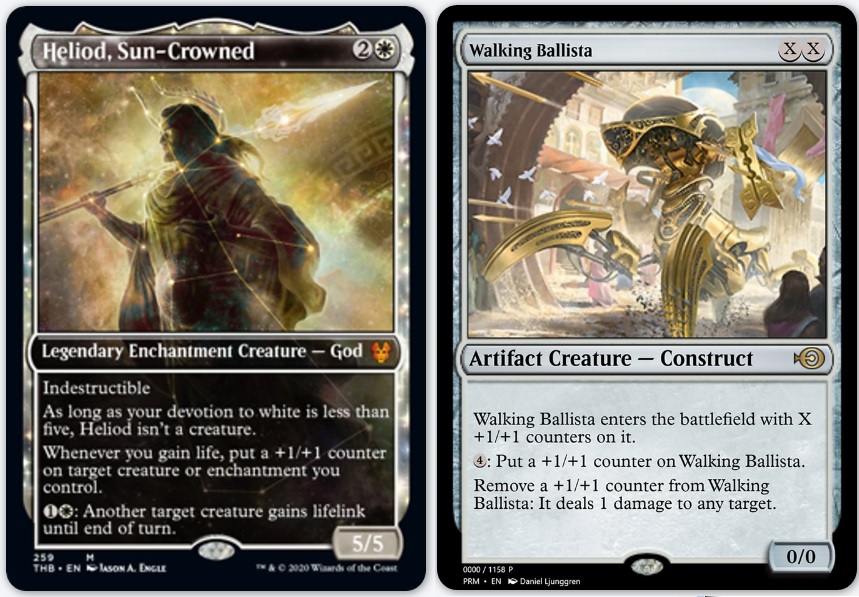
I know that some of you wonder at why we would want to play games that have “stalled board states”, and I shake my head in response. What is the definition of a stalled board state? Stasis lock? Stax decks employing oppressive tactics with Goblin Welder and Smokestack? People having developed armies of creatures and waiting to attack each other? Those are pretty different circumstance. Ultimately, the only stalled board states exist when people are playing that sub-game of politics within the normal bounds of Magic. A stalled board state doesn’t require an infinite combo to break it up. It simply requires some bravery, a bargain perchance, or even a little stupidity or gullibility. It requires an over extension, a leap in faith, or perhaps simply a wrath effect. These states do not require a combo to end the game. When creatures have stalled the game we don’t have to turn to a combo. Those players have been fighting and maneuvering to position themselves into defensive states with the hope of taking the offensive. The armies and resources amassed have been building all game long, and then when they are a turn or two from breaking the “stalled” board, the combo says, “it doesn’t matter what your plan was, because the game is over.” The clash of armies, and the activating of artifacts doesn’t matter. There are no repercussions for an attack, and there is no further drama. The game is over. Anti-climatic really. I mean all that fuss and Heliod, Sun Crowned and Walking Ballista just ended it all. That’s a salty ending indeed.

The ease with which a player can call together the pieces of their combo also helps to determine if it is something that seems viable and acceptable by the table at large. The more pieces required to make the combo work, then the more exciting it could potentially become. A two card combo isn’t nearly as exciting as watching someone pull off a four card combo to win the game in a very unexpected and ridiculous manner. When someone pulls off a win with The Cheese Stands Alone…er I mean Barren Glory or even Happily Ever After it is much more satisfying than seeing someone cast Approach of the Second Sun for the second time in the same game. It also feels a lot more exciting when you can interact with that combo and keep it from fusing into that game-ending synergy. This requires work on both the combo player’s part and those that play with the combo player. We need to have interactive cards in our decks in order to avoid stalled board states and instant losses to coalitions of cards popping off. A little interaction goes a long way. It helps build drama and requires the combo player build some redundancies into the deck to account for people interrupting their ability to muster all elements required for victory. However, we still have to wonder what that combo looks like. Is it a focused two card combo to snatch games from having climatic finishes? Or are those combos in the deck merely synergies that allow further development and encourage interaction and the ebb and flow of the game to continue. The way a deck plays helps decides how fitting it is for the casual Commander environment.

How do you get a player in your group to move past their infinite combo kick?

I don’t mind if someone wins with their Commander every time, but I certainly don’t enjoy playing against the same combo every play session. That grows stale for others even faster than it does for those that are playing the combo. I remember playing regular multiplayer. We had eight or so of us playing. My friend Jeff was on an infinite combo kick. He would proceed to take a twenty minute or longer turn in which he would either fizzle out and kill himself (those were the glory days of mana burn), or he would kill all of us as once. That was miserable. So, we figured out a way to stop him from doing this. After he announced his combo, played it out, and then “won” the game, we all decided we would continue playing for second place. We would include him in our next game. The game would invariably stretch on for at least another hour or so (or hours if we managed to live the dream and cast multiple Forks on someone’s Shahrazad). He got the message pretty quickly that we hated playing against that deck. It was fun for him, but the rest of us didn’t have any fun. Am I advocating that you should solve your own play group issues by playing for salty seconds? Yes, yes I am. Does this make me a sore loser and more importantly, are you if you employ this tactic? No. No, you are not. You are attempting to fix a problem. The problem of infinitely repetitive play in a format that people often come to in order to find variety and dream fulfillment. I have never experienced a format where I was able to hard-cast four ultimatums in a single game, and still lose. No, I did not lose to an infinite combo, because if the combo had existed, I suspect I never would have made it to casting the third ultimatum.

Is it against the spirit of the format to include combos that crush your friends while denying them the opportunity to live their dreams? Yes. You may not agree with me, but everyone is allowed to be wrong now and then. If you feel you must build an infinite combo oriented Commander deck, then I highly suggest that you make it as a side project. Do not make that deck your only deck. This style of deck building, at least in Commander, is something that should be approached as a secondary project. Sure, this mistress may become your little obsession, but it could burn you worse than Scorch Thrash with a Mana Flare and Over Abundance lending a hand. Using this style of deck building as a mad scientist’s side project will keep you from becoming Mr. Hyde and allow you to command the kind of respect Dr. Jekyll deserves. The decision to employ game-ending infinite combos is a personal one, but it is also one that will affect your friends. I’m not convinced that casual Commander is the place for game ending infinite combos. So, should we be playing them in our decks? No, but don’t let that stop you. You can do whatever you want, but don’t be surprised if you suddenly find yourself waiting while your friends play for salty second. 

If you enjoyed this article, then please consider subscribing to my blog. Subscribing will send new articles directly to your inbox. You won’t have to check back to read any fun new Magictations. Thanks for reading! Feel free to drop me a line below.
40 at 40: A Childhood Wrong Righted

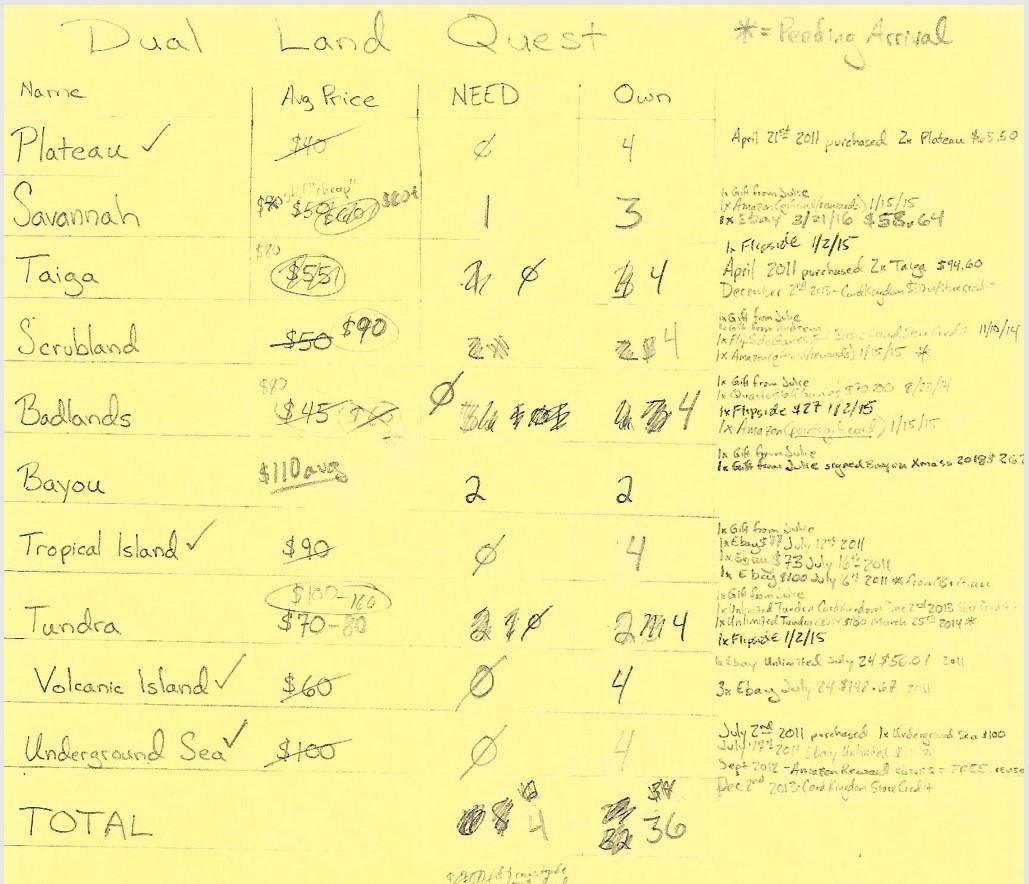
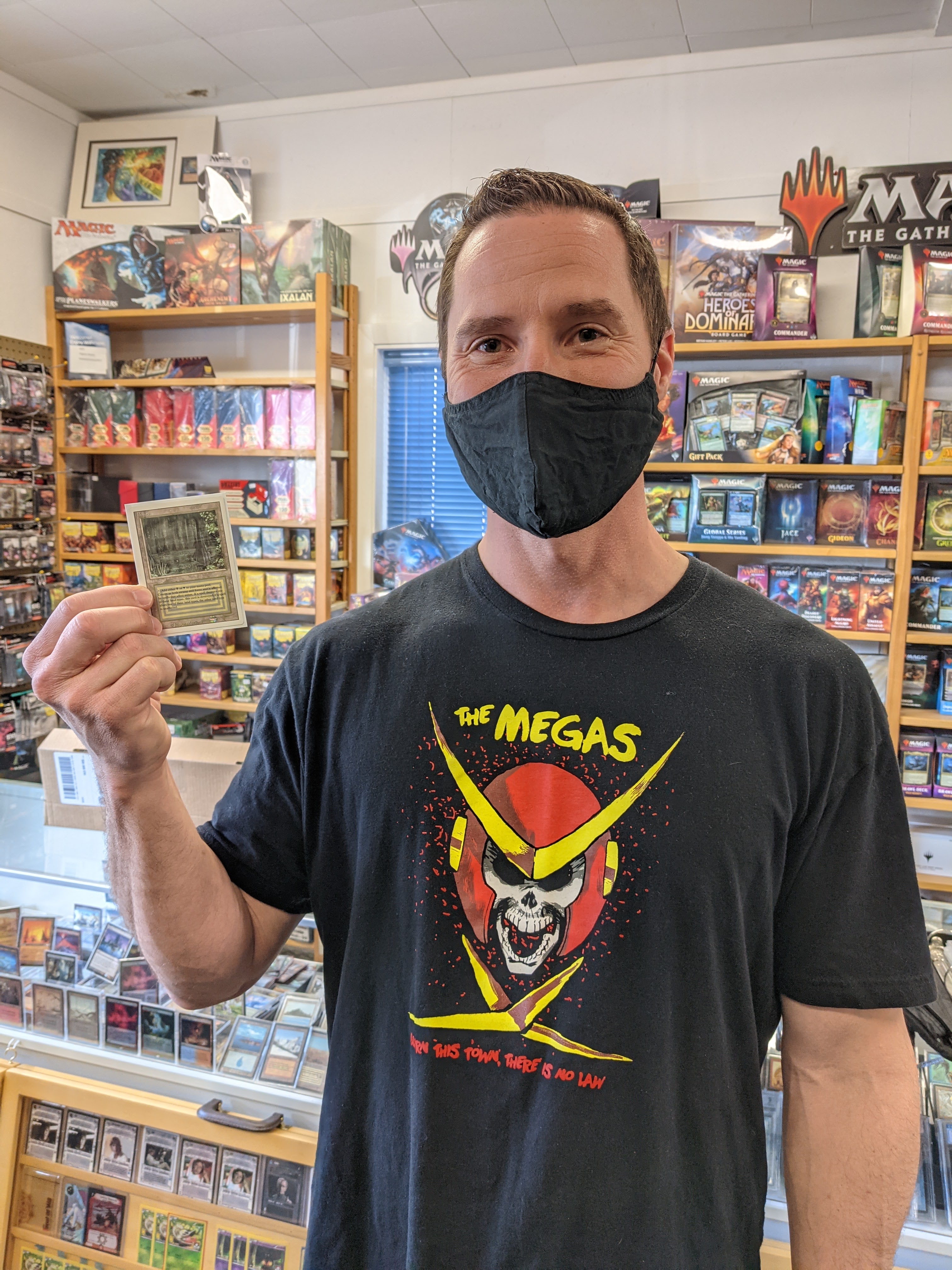
My best friend Doug once said to me, “How many chances do you get to right a childhood wrong?” To be forthright with you, this is an indulgent little article. I turned 40 yesterday, and I finished my dual land quest. I’ve written about this quest before, and I’m happy to say that I’m going to finish it today. I sold off my play set of all 40 dual lands nearly 20 years ago. About ten years ago I made the decision to right that childhood wrong. I can finally say that I have fixed my childhood regret.

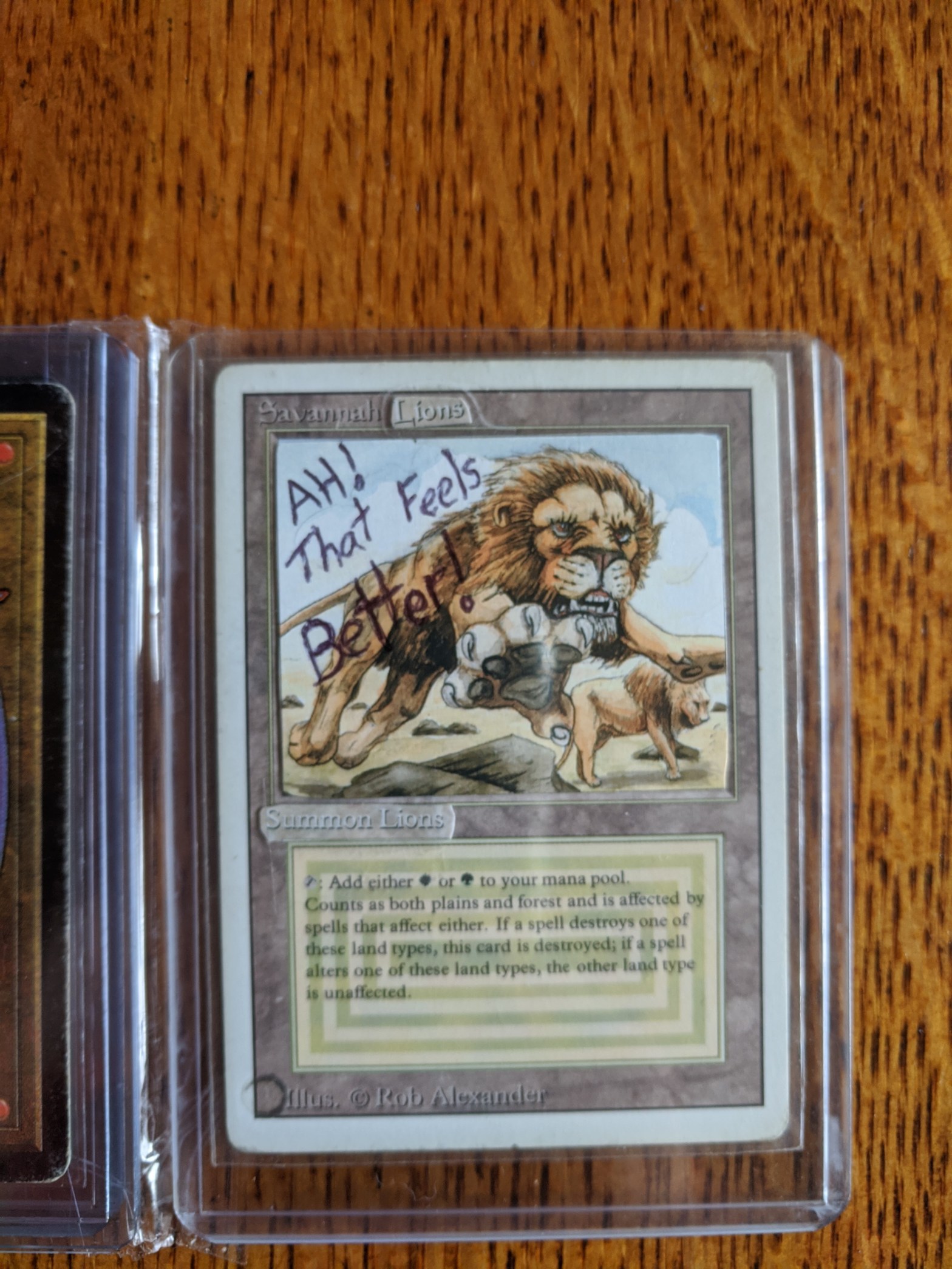
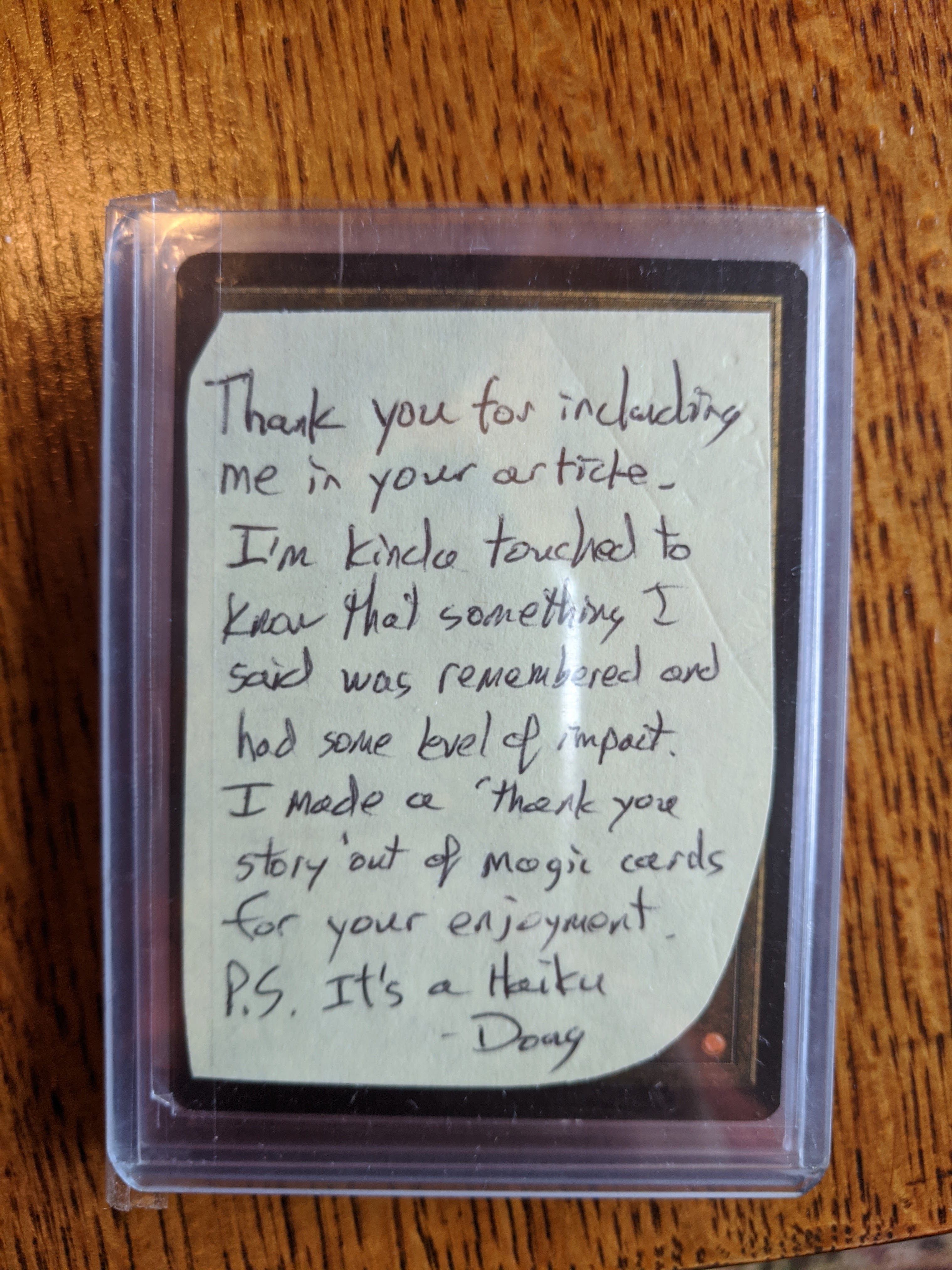
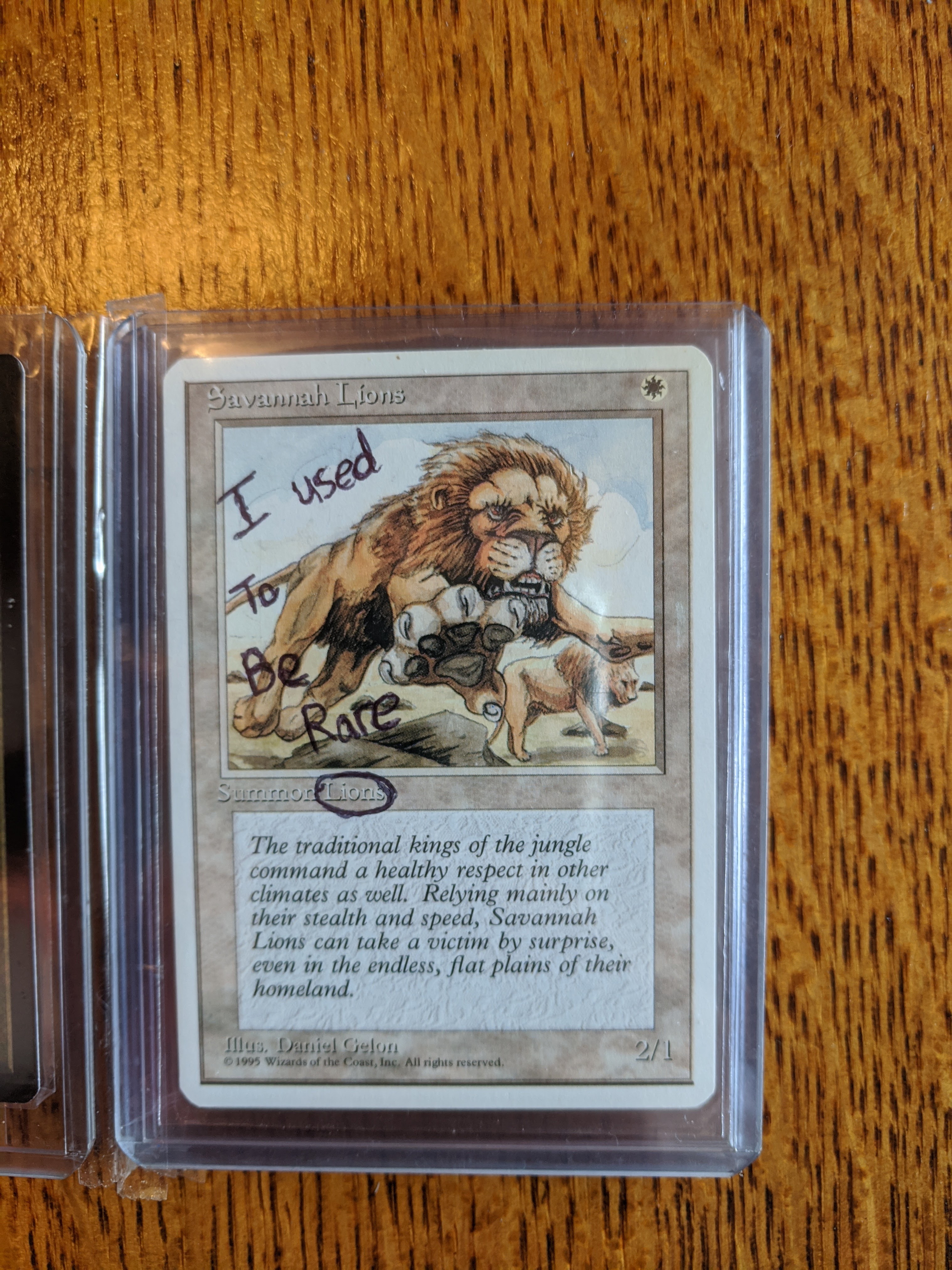
Doug came over to drop off a gift for me. It is one of the most thoughtful and amazing gifts I’ve ever received. I was crying as I was reading it and going through it. It was so unexpected and incredibly thoughtful. I’m posting pictures of it below so you can appreciate how special it truly is. He presented me with a little book of cards taped together using hard case sleeves. As I opened it up, it was just amazing to see. He had cut up a few Savanah Lions and a plains, and hid an amazing present inside in order to bring me one step closer to my goal. So, now I would only need a single Bayou to “right my childhood wrong”…and so I have.

It was really an incredible gift. I’m a Magic nerd, and I’m an English teacher. He gave me a book that was Magic cards turned into a haiku with a Savannah hidden in plain sight…NAILED IT!

Yesterday, I traded in a couple cards I had extras of to make the purchase a little easier on me. The current prices for dual lands are a bit higher than when I started my quest. Plateau’s were $40 a piece back in 2011. Savannah, Scrubland, Badlands, and Taiga were around or below $50. I was gifted many lands over the years from my wife and friends, and those gifts have gone a long way toward helping me rebuild the collection. In 2012 Andrew gave me an Unlimited Scrubland. I imagine the market price at the time was around $70. Looking at today’s market puts it close to $600-900. It’s worth nearly 10x what it was 10 years ago. That’s a bit mind boggling. I’m so glad that I started this quest when I did. It would be so much more expensive to rebuy them all if I started out today. I remember seeing auctions for all 40 when I first started, and those auctions would go for anywhere between $1500-$3500 for all 40. As I’m writing this I looked over at eBay to see if any auctions were up for a set of 40, and I found this:

Dual Land Auction for 40 Duals…$30,500

Condition and edition influence prices an awful lot, but overall it comes down to the simple economics of what you are willing to pay. Often times you would see a couple unlimited duals thrown in with people’s mostly revised sets. My original set had at least one unlimited for each land, but I made the concession early on that I would be totally fine just getting revised copies. I have still tried snagging an Unlimited copy here and there whenever it was close in price. However, the gap between Revised and Unlimited copies has widened considerably in recent years.

This little yellow paper was my records sheet for keeping track. It isn’t fully updated, but it’s a nice artifact to symbolize how special and how meaningful this collector’s quest has been. I recorded most of it in pencil so I could update whatever the current prices were as I went. Trading cards in to acquire others has been one of best ways for me get the cards I’ve wanted without sacrificing too much of my budget. I used to love trying to trade my way up to more and more value. I have found that most of the time I can manage to trade away cards at their peaks and snag others at their lows. That’s not to say I haven’t made a few foolish trades, because of course I have. Trading away my Gaea’s Cradle for a Berserk a long time ago was one such instance. I also traded away my Shaharazad and Ali from Cairo too I don’t remember what I traded them for, and that means it wasn’t anything with lasting value. The best items for me to unload were easily the foil basic lands and promo cards that I had functional replacements for. I didn’t lose any play value. Even if I had lost a little collector’s value (which I didn’t) it would have been worth it for the amount of play value dual lands have given me. Seeing the old dual land text box is something that has always brought me joy. I never should have sold them the first time, but I’m happy to say I have them back.

The final card I needed was a Bayou. Today I went to my LGS, and I picked up a Bayou. I traded one of my Serra’s Sanctums to ease the price tag a bit. I had bought four Serra’s Sanctums quite some time ago. It was shortly after someone managed to top 16 a Legacy tournament with a Leyline’s deck that used Serra’s Sanctum to cast Opalescence on turn 1. It was a silly deck, and I played it at a few Legacy tournaments, but overall I figure I’m probably not going to play that deck again. If I do, then I will probably run it with just three Sanctums or perhaps I’ll actually play a “real” Legacy deck. I have all the pieces for quite a few Legacy decks that are far more competitive than the Leylines deck. It just makes good sense to take something I only paid $25 for and use it to buy a dual land at more or less half the price.

Serra’s Sanctum approx. worth $300

When I started this quest I prioritized getting the blue duals, because they were the most expensive. I figured they were the most likely to go up in price first. I wasn’t wrong, and I’m glad I decided to take that path. Looking back, I was able to purchase 3 Tropical Islands for $250 in July of 2011 and the 4th was a gift from my wife. I think she basically stole it for around $45. Compare that to the current cheapest price of $610 for a heavily played Tropical Island, and I did pretty well. The NM Unlimited Tundra I picked up for store credit trade in (foil lands and a foil Jace Beleren book promo) was totally worth it, because that same Tundra is worth more than 10x what I traded for it. Blue duals have long been the best, but the others have all crept up in value too. I also figured that picking up the cheapest ones whenever I saw them was a good idea as well. I always made a point of trading for them if people were willing. Yet, when I began this quest in earnest it was 2011 and most people were either unwilling to trade duals or would only trade duals for duals. Basically, no offers were worth taking. It seems likely to me that trading for duals is not an easy task. Buying them is also difficult, but can easily be worth it if you prioritize your mana base or just simply want the best lands ever made. I know that I enjoy playing with them, and they can certainly be the type of card that is appreciated by all. The fluctuations in the prices among the lands have usually correlated with whatever Legacy decks were best. With Legacy on the decline and Commander on the rise I wonder if that will no longer be the case. It’s certainly possible. Either way, I suspect that duals will probably just keep increasing in price. They are on the reserved list, so collecting them seems pretty safe to me. I can’t say that I’ve ever regretted a single moment on this path to reacquire them.

This quest has been a special one for me. I always loved playing gold/multi-color spells. I have loved legendary creatures since I first got swampwalked by the king himself–Sol-Kanar the Swamp King. So, it’s no wonder that I regretted shipping off those cards. I say this, because I’m not sure I would want to try and buy back every card I once owned. I used to own an Unlimited Black Lotus, a Beta Mox Jet, and an Unlimited Time Walk. I bought those for their going rates and sold them each for a slight profit around the same time I shipped off the dual lands. I miss them more as collectible pieces than as play pieces. It would be cool to still have power, but I’m not certain I’d be playing with them anywhere outside my cube. Actually, I would probably not even put them in the cube, because they’re just worth too darn much. It’s great to be able to play with the old cards, but I don’t have a burning desire to own them just yet. Perhaps that will change, but for now I’m supremely satisfied to have all my duals in decks, and another collector’s quest complete. Next up is probably finishing my original legends from Legends, but with a fun little twist to make it even more of a challenge. Best wishes and happy shuffling my friends!

Looking to play more Casual Commander, but you keep running out of friends?

It’s not whether you win or lose, but how you play the game. 

Part 2

A Magictation by Mikeal Basile

“Magictating” is defined as getting into the zone with your Magic the Gathering collection–thinking, planning, organizing, reminiscing about past games, and imagining future games. It is a combination of hard thinking about the game and calm meditation, reveling in the joy it brings you.

Last time I spoke about the first two most common priorities for an antisocial gamer. The basic goals of Magic have always been to win by either reducing your opponent’s life total to zero or running them out of cards. However, when playing non-competitive Magic with friends or friends-to-be, you should pay close attention to how you plan on winning. How you build your deck matters, but perhaps not in the ways you might think. Your priorities when sitting down to play reveal an awful lot about you. Let’s quickly review the priorities that an antisocial player sets:

1.      Win at all costs.

2.      Spite those that defeat me.

3.      Optimize all cards.

4.      Consistent lines of play.

5.      Follow the rules.

To summarize what I covered in part 1 of this series the first two elements can be treated as such:

1.    Having fun comes first, and winning is an after effect.

2.    Every game is new, so don’t carry a grudge into the next game.

Shifting your focus away from winning and being spiteful means you’re well on your way to being a social player. So, please avoid being a soul-crushing fun killer, and embrace the social games offered by casual Commander.

Optimization vs Maximization

A long time ago, in a great local game store called, The Gamer’s Bazaar I was playing a friendly game of multi-player Magic. I remember I cast a Scaled Wurm, and the guy sitting across from me goes, “That’s sub-optimal. Why would you play that card?” I was perplexed. Why wouldn’t I play Scaled Wurm? It has an awesome picture, reminds me of the original Craw Wurm, which I love, and it has cool flavor text. He wasn’t asking me nicely either. He was mocking me for playing Scaled Wurm. So, I asked him, “Why shouldn’t I be playing with it?” He replied with, “It’s sub-optimal.” I shook my head and realized that I was about to get into an argument that I couldn’t win, and would only result in me walking away frustrated with my inability to convince this guy that playing Scaled Wurm is a great idea. Now, to be honest with you, non-casual players shouldn’t play with Scaled Wurm. I have nothing against pro-players or those of you that enjoy hyper-competitive play—but those people are wrong about Scaled Wurm. I’ve already mentioned several reasons to play with it, but the biggest and best reason is because I want to play with it. I want to cast that card, and no one is going to mock me for my Ice Age vanilla 7/6 with long flavor text. We had lengthy discussion which may have been heated at times, but the result was my friends and I later agreeing that we wouldn’t bother playing with that guy again, because he’s just no fun.

If you find yourself looking around the table and shaking your head in disbelief that your opponents are running so many sub-optimal cards, then perhaps casual Commander is a puzzle you are far from cracking. Stop trying to optimize. Yes, I said it, and I’m going to say it again in other ways. People cry out about Commander becoming an arms race, but that’s only the case when people are trying to optimize. Don’t optimize, and instead maximize. Maximize your fun, your flavor, and your nostalgia. Toss cards into your deck because you think it might be a neat play. Toss cards into your deck because you love quoting the flavor text from them. I love reading the flavor text for Deflection as I’m casting it. Don’t be a slave to optimization. Optimization is the easiest way to find yourself becoming the archenemy of the table, and then eventually without a table to play at all.

Consistency Sucks

I like to be consistent. I like to think that the students I teach, the friends I know, and my family all think of me as a consistently dependable person. However, if I were to carry over that consistency to Magic deck-building, then I might find myself a lonely antisocial player. Commander has its roots in being a format where you were traditionally forced to have a fairly inconsistent deck. Yet the format has developed significantly with products like Commander preconstructed decks, Brawl decks, and the huge influx of design choices in Commander Legends; the pool of cards ideal for the format just continues to grow. This leads to the aforementioned problem of optimization. However, it can also lead to incredibly consistent decks. When I look over cEDH decklists I find they seem to be like some sort of Legacy monstrosity. A cross between a Battle of Wits deck and a Legacy deck, which if that’s your jam, then great. Those decks are trying to be as consistent as possible. They lean into tutoring effects and redundancy. In friendly Commander, that is the sort of thing that will get you booed out of a pod or home game rather quickly. I know we are in the age-of-Covid, but when we do play in-person again, I think you’ll be happier if you get invited back to the kitchen table. Your invitation depends on you being social. You don’t have to build a group hug deck, but you shouldn’t be building hyper consistent decks either. You don’t need to do that at all. In contrast, you need to be sure that your deck doesn’t just consistently perform exactly the same every single time.

Sure, you can play a Voltron-style deck, and it will win by attacking with your Commander. However, if you are tutoring up the same enchantments and artifacts, and you do it in the same fashion each time, well, people are going to be bored. This is why Zur, the Enchanter decks are so reviled in friendly pods. Those decks win the same way every single time. That sucks for everyone. I contend that it sucks for the player winning too, because it won’t be long before you’re not invited back. Consistency leads to antisocial behaviors in friendly Magic. So, avoid it by building inconsistency into your deck. Eschew tutors, and instead toss in some spicy or sub-optimal cards. Experiment with new haymakers, or sub-optimal cards and you’ll find that you and your friends have more fun.

Rules Lawyering

Every group needs a judge. No, you don’t have to have someone that is an actual judge, though it is nice. Instead, you simply need a player or two that has a deep understanding of most of the rules. However, a phone and a quick gatherer search will often suffice as well. A good rules lawyer tries to find ways to legally bend rules or exploit them to do ridiculous stuff. That’s OK too. However, if you are the one who is always questioning the play and trying to negate people’s spells by calling everything into question, then you become the annoying rules lawyer. That person is an anti-social jerk. I don’t mean that you are a jerk for keeping up the rules of the game. I mean you are a jerk for instigating fights over rules, you grumble about missed rulings, you begrudge mistakes, and you cast doubt on other people for trying new things. The antisocial rules lawyer also feels the need to belittle others for their inferior knowledge of Magic’s comprehensive rulings concerning rules 508.1e and 702.21j-m.

Magic is full of stumbles, and stumbling in multiplayer Magic is normal. Forgetting upkeep triggers or missing activations is normal. You can decide if you are doing to be a stickler on these or not. I would suggest finding balance between allowing a little, but not allowing it all. You really do get better by punishing yourself for missing triggers and upkeeps and activations. If people allow you to take everything back, then you end up cultivating sloppy habits. Those habits usually aren’t a problem, but can cause real issues when it’s time to resolve game-ending spells or combats. Again, it’s fine to give some leeway, and I’m more apt to punish myself than let myself play loose, but don’t force people to be punished every time. That’s just mean. Yes, it’s the rules, but when you’re playing multiplayer and you’re playing for fun, then the rules are actually secondary. The cardinal rule is the social element, and the social element decides if you were an opponent who added to the experience. In the world of givers and takers, you want to be a social giver, and not a party pooper.

What’s the social thing to do?

So, rather than leave you with a list of what not to do, let’s focus on the  top five thoughts you should be having when playing casual Commander:

1.    Have fun with friends.

2.    Each game offers new variety.

3.    Play sub-optimal cards because they are fun.

4.    Mix up your gameplay approach.

5.    Mistakes will happen, so laugh about them.

6.    Maybe win some games? If not, then check back with step one for the real sense of winning.

Playing Happily Ever After

Gaming environments are fragile, so treat them carefully, and they will blossom. You don’t have to win at all costs, optimize your deck, play hyper consistent builds, and make certain no one is allowed a misplay in order to win friends and influence people. Actually, that’s exactly how not to gain friends and influence social gamers. I’m not saying there isn’t a place for these styles of play. It’s just not at the kitchen table (or kitchen spell table). Not every playgroup is the same, and not every group will groan about all of these behaviors. You need to be aware of these things, scope them out, and if you enjoy the style of play a group engages in, then by all means have fun! The key to having fun is allowing each other to live your dreams, but also to do so with agreement that we are playing for fun. Does that mean winning is fun? Sure, it absolutely can be, and it’s even better when it’s fun for the losers too. It’s fun when you have epic games, and interesting interactions. The more you pay attention to the tenor of the table, and the ebb and flow of play—both mechanically and socially—then the more fun, friends, and games you will be able to enjoy. Until next time, I hope you get invited back to your new social playgroups for some casual Commander games!

Looking to play more Casual Commander, but you keep running out of friends?

It’s not whether you win or lose, but how you play the game. 

Part 1

A Magictation by Mikeal Basile

“Magictating” is defined as getting into the zone with your Magic the Gathering collection–thinking, planning, organizing, reminiscing about past games, and imagining future games. It is a combination of hard thinking about the game and calm meditation, reveling in the joy it brings you.

Commander is the premier social format. It is non-competitive Magic for multiplayer social gaming. Multiplayer Magic has always been a solid choice for casual gaming. The beauty of Magic is that it has so many ways to play and tiers of play within those ways or formats. There’s a format and style for everyone. However, if you’re getting into Commander, then you may be playing it all wrong. You need to play like a social gamer, and not an antisocial gamer. Do find that you’ve played a few times with a few different groups, but no one seems to be inviting you back? Well, it’s probably because of your lapse in basic hygiene. No, I’m only kidding. It also is decidedly not because you have scared everyone with your superior intellect. No, it’s not even your supreme deck building skills that scared the rabbits into their holes. You’re probably playing like an antisocial player at a socially tiered game. Those don’t mix, and if you can identify what antisocial tendencies you have, then perhaps you can fix those problems and find yourself a regular playgroup or two. So, let’s take a look at what antisocial tendencies you might have, and how to avoid engaging in those, so you can play more Commander with all the cool kids.

The basic goals of Magic have always been to win by either reducing your opponent’s life total to zero or running them out of cards. However, when playing non-competitive Magic with friends or friends-to-be, you should pay close attention to how you plan on winning. How is your deck built? What are your priorities when you sit down to play? Let’s take a look at the priorities that an antisocial player might set:

1.      Win at all costs.

2.      Spite those that defeat me.

3.      Optimize all cards.

4.      Consistent lines of play.

5.      Follow the rules.

These are not necessarily bad traits or qualities to have as a Magic player. I simply mean that when these things become priorities 1-5, then you’ve forgotten the format that you’re playing in. This is not tournament Magic, and it isn’t even tournament practice. Casual Commander is not a competitive format, so winning actually needs to be secondary (if not tertiary). I know this sounds counterintuitive to many. I’m sorry, but that’s part of what is making you an antisocial player. Stop worrying so much about winning, and start believing in the socialization the game offers. You get to tell your story, show off your style, display your skills, and create your Magic opus. Yet, you do so while allowing others a chance to live their dreams too. I’m not saying you shouldn’t Mana Drain someone’s Finale of Devastation where X is equal to 20. Please, do it. It’s a cool story and a big moment. Except, when you do so, don’t be a jerk about it. When you win the next turn, be sure to make it quick and easy, and not some vile and drawn out vice-like defeat. No one wants that, except maybe you. That’s because you value winning at all costs. If it means your opponents don’t get to play Magic, that doesn’t matter to you. Stop right there if that thought crossed your mind. You should care if your opponents aren’t getting to play. To the antisocial player it doesn’t matter how cheesy, fast, or unfair a combo is. They use it and win with it. Gin-Jitaxis on turn two? If that sounds perfect to you, then we need to change your outlook on casual Commander. That line of play effectively shuts out other people’s decks from doing their thing. Again, you want to let people do their thing, but also allow yourself to do yours. The ends do not justify the means, and that’s doubly so if you place winning first.

The social player approaches the game as an event. The goal of the game is to experience the game. Winning is a happy byproduct of the gaming experience. You don’t expect to win every game. Heck, I know plenty of players that start games expecting to lose, but play anyway. The antisocial players are not sitting down to play a game that they feel certain they will lose. The antisocial gamer places winning above all other goals. You need to have a little “Johnny-Combo player” spirit in you for Commander. You need to want to play the game to see if things work out. Watch to see if you find a way to turn things in your favor despite the odds, deck building, and general luck not being in your favor. You need to sit down to play and not feel like you can win every single game. Now, I am personally a very competitive person. I do try to win every game I sit down to play. I do not expect to win every game, but I try to. I also sit down trying to win when I feel like I probably can’t. I take the time to build decks that shouldn’t win very often, but are all the more sweet when they do. That’s the beauty of the Commander format. You can be rewarded for not making winning your top priority. Also, when you build your deck to do its thing without ruining other’s abilities to do their thing, then you are winning the social game as well. You want your friends to enjoy playing with you. This doesn’t mean they just crush you all the time and enjoy having you be the easy kill. It means that there is a give and take and an ebb and flow throughout the matches. It’s like how a healthy relationship at any level involves listening to the other person and caring about how they feel. At its most basic, social Magic is a social contract of sorts, and if you abuse, break or otherwise ruin that contract, then you won’t be playing much.

Spite is awful.

Priority number two for many antisocial gamers is spite. This looks exactly how it sounds—spiteful. Let’s say that Johnny’s infinite combo attempt was thwarted by Phil on turn five, and Johnny is left with no permanents on board and is slowly picked off throughout the course of the game. The following game Johnny, the antisocial player, immediately rips into Phil. I don’t mean verbally, or even physically. I mean Johnny relentlessly assaults Phil until he’s dead—preferably by turn five or sooner. The antisocial gamer’s goal is to spite whoever stopped them. The goal shifts from winning to making sure someone else loses. It’s awful, but I’ve seen it many times. If you’re the target of a spiteful player,  you suddenly find yourself playing a one v one game, when you thought you’d have the cushion traditionally offered by having multiple players. The inflated life total just isn’t enough of a barrier when a player has decided to single you out for elimination. Oftentimes the antisocial player has a deck or decks that are designed to be hyper aggressive, and despite priority one, probably won’t win the entire game. These are decks constructed with spite in mind. If you have decks like these, and you use them in this manner, then you might be an antisocial gamer. I’ve been on the receiving end of this madness many times. I’ve also born witness to it. I don’t want to see it again, and I find myself always watching for it whenever I am playing with new people or in new groups. The spiteful players are antisocial crooks. They steal the fun from the game, and ruin the multiplayer aspect.

A  social player simply accepts losses and moves on. Sure, you might’ve almost had that game, but you didn’t. Perhaps next time, or perhaps never. Either way, you are sure you’ll get another crack in against everyone. You don’t hold a grudge. The most the social gamer holds onto is the information that whenever your buddy is playing that Narset deck you know what card is likely being chosen when Mystical Tutor resolves. Beyond gathering information to inform your plays, there’s no reason to be carrying grudges into future games. Grudges are unhealthy in our daily lives, and they are even worse in our escapes from our daily lives. Heck, even if Magic is part of your daily life, then just let it go Elsa—stop holding a grudge.

I hate to hold back the rest for now, but I think these first two concepts are the biggest and most important pieces to get you off the antisocial train. I don’t mean to get preachy here, but I feel we should all be aware of what these behaviors look like, and take steps to police ourselves and others. If we see the antisocial gamer taking over our casual Commander lives, then perhaps it’s time to take a step back and reevaluate what drives us to play this format, and what social tier we are playing. Whenever you are new to a group or new to store or new to an online pod, we find ourselves feeling nervous, excited, or perhaps nervouscited? The good news is that if we approach each new game as both a learning experience and a social opportunity, then we can find ourselves creating future opportunities to grow as players and people. Until next time, keep socially distant, but avoid being an antisocial gamer.  

If you enjoyed this article, then please consider subscribing to my blog. Subscribing will send new articles directly to your inbox. You won’t have to check back to read any fun new Magictations. Thanks for reading!